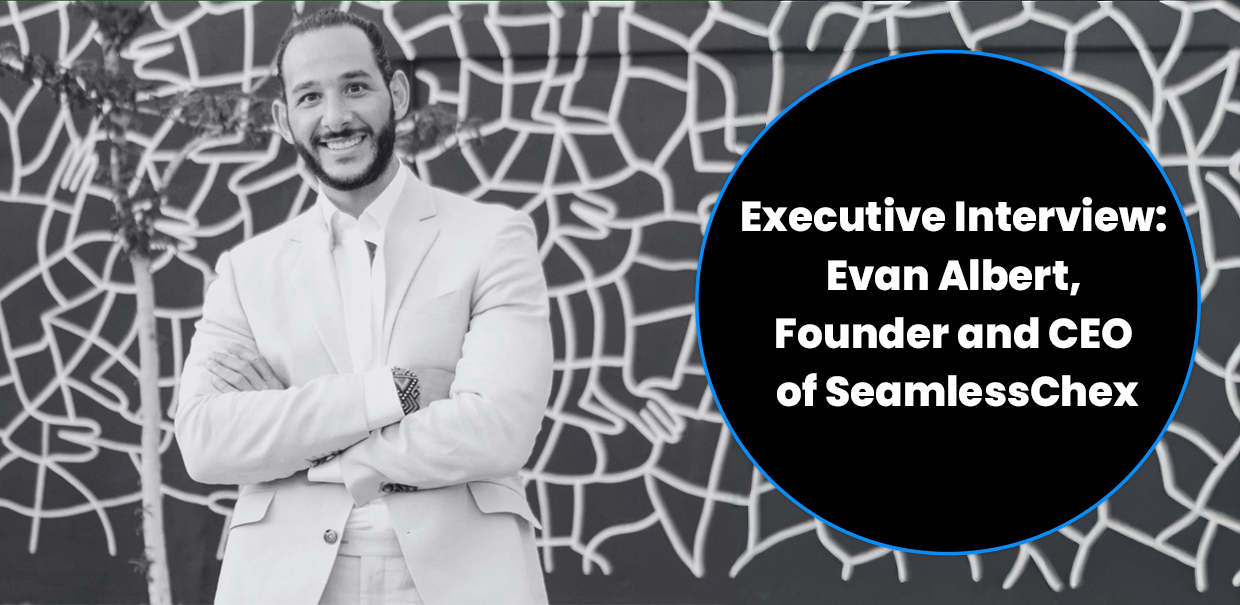
Over the past several years, we’ve witnessed a major inflection point in payment processing and merchant services—one that’s redefining how high-risk businesses access financial infrastructure, manage transaction risk, and maintain operational continuity. Traditional underwriting models have left thousands of legitimate merchants without payment solutions, creating a significant gap in the market. Today we’re fortunate to interview Evan Albert, Founder and CEO of SeamlessChex, the company with the highest approval rate for high-risk merchants. Evan’s company has pioneered specialized underwriting methodologies that allow them to approve merchants other processors routinely decline.
At 7T, we develop AI-powered enterprise solutions that transform how businesses operate, and we’re particularly interested in how intelligent systems are reshaping financial services. Payment processing represents a critical infrastructure layer where AI-driven risk assessment can unlock opportunity for previously excluded businesses, so we were eager to hear Evan’s perspective.
Q: Evan, for those unfamiliar with the industry, what technically defines a “high-risk” merchant, and why do traditional processors systematically decline these businesses?
A: High-risk classification is driven by a combination of chargeback probability, regulatory complexity, and reputational factors that underwriters associate with specific business models. Industries like CBD, nutraceuticals, subscription-based services, telemarketing, adult entertainment, and certain travel services fall into this category, not necessarily because they’re illegitimate, but because historical data shows elevated dispute rates or because they operate in regulatory gray areas. Traditional processors use rigid scoring models that automatically decline applications based on merchant category codes (MCCs) or business verticals, without examining the actual business operations. They’re optimizing for risk minimization rather than risk management. At SeamlessChex, we’ve built proprietary underwriting frameworks that evaluate each merchant individually, analyzing their business model, processing history, compliance infrastructure, and operational controls. This approach is why we maintain the highest approval rate for high-risk merchants in the industry. We’re not just approving more applications; we’re identifying quality merchants that legacy systems miss.
Q: How are AI and machine learning specifically being applied to improve approval rates while maintaining security in high-risk payment processing?
A: The application of AI in high-risk underwriting represents a fundamental shift from binary decision-making to probabilistic risk modeling. Traditional underwriting asks, “Does this merchant fit our risk profile?” AI-driven systems ask, “What is the specific risk vector for this merchant, and can we mitigate it?” We use machine learning models trained on thousands of merchant processing histories to identify patterns that human underwriters might overlook. For example, our algorithms can detect that a nutraceutical merchant with certain fulfillment practices and customer service protocols has a chargeback rate comparable to low-risk retailers, even though their MCC would trigger automatic decline elsewhere. On the fraud prevention side, we deploy real-time transaction monitoring that uses anomaly detection to flag suspicious patterns before they result in chargebacks. The system learns normal behavior for each merchant and alerts on deviations; like sudden geographic distribution changes or velocity spikes. This is where AI development firms like 7T are invaluable: the technical infrastructure for real-time decisioning, model training pipelines, and interpretable AI outputs requires sophisticated engineering. The future of high-risk processing isn’t just about better algorithms; it’s about building entire technology stacks that turn risk assessment into a continuous, adaptive process
Q: Can you walk us through what high-risk merchants should look for when evaluating payment processors, and what red flags indicate they’re working with the wrong partner?
A: The most important criterion is approval methodology – does the processor have genuine expertise in your specific vertical, or are they simply accepting high-risk applications with inflated rates? You should ask potential processors about their approval rates for your industry, their acquiring bank relationships, and their average time-to-approval. At SeamlessChex, we maintain direct relationships with acquiring banks that specialize in high-risk verticals, which gives us approval pathways that aggregators don’t have access to. Second, examine the fee structure transparency. Many processors advertise competitive rates but bury costs in monthly minimums, PCI compliance fees, or early termination penalties. High-risk merchants often face legitimate rate increases compared to traditional retail, but those should be clearly disclosed upfront. Third, evaluate their technology infrastructure – do they offer robust fraud prevention tools, real-time reporting, and API integration capabilities? A processor that can’t provide detailed transaction analytics or integrate with your business systems will create operational friction. Red flags include processors that require long-term contracts before approval, those that can’t explain their underwriting process, or those with no verifiable track record in your industry. If a processor promises instant approval without reviewing your business model, that’s actually concerning. It suggests they’re not doing proper due diligence, which often leads to account instability down the line.
Q: What are the most critical mistakes high-risk merchants make during the application process that damage their approval chances?
A: The biggest mistake is incomplete or inconsistent documentation. Underwriters need to see a complete picture: business licenses, processing statements from previous processors, detailed product descriptions, refund and return policies, and customer service protocols. When merchants provide vague descriptions or incomplete histories, it raises red flags even if their business is completely legitimate. Another common error is applying to multiple processors simultaneously without understanding how that appears to underwriters. Each application inquiry gets recorded, and a pattern of rejections creates a negative signal. Merchants should be strategic and work with one specialized processor at a time, rather than shotgunning applications. Additionally, many merchants underestimate the importance of their online presence. Underwriters will review your website, social media, and online reviews. If your website lacks clear terms of service, has poor security indicators, or shows inconsistencies with your application, that’s grounds for decline. Finally, merchants often choose processors based solely on rate shopping without considering approval probability. Applying to a low-risk processor because their rates are attractive is almost guaranteed to result in rejection, and that rejection then makes it harder to get approved elsewhere. The smarter approach is working with a specialized high-risk processor from the start, even if rates are slightly higher, successful approval and account stability are worth far more than marginal rate savings on an account you’ll never get.
Q: Looking ahead, how do you see AI and emerging technologies reshaping the future of high-risk merchant services?
A: We’re moving toward a future where risk assessment becomes hyper-personalized and dynamic rather than categorical and static. Instead of declining all CBD merchants or all subscription services, AI will enable processors to evaluate the specific risk profile of each business based on hundreds of variables – customer acquisition methods, fulfillment timelines, customer support responsiveness, historical dispute resolution patterns, and even sentiment analysis of customer reviews. This granular approach will dramatically expand access to payment processing for legitimate businesses currently locked out. Blockchain and cryptocurrency rails are also creating alternative settlement mechanisms that bypass traditional card networks entirely, which is particularly valuable for international high-risk merchants facing cross-border processing challenges. We’re also seeing the emergence of embedded finance, where payment processing becomes deeply integrated into vertical SaaS platforms. For high-risk industries, this means purpose-built platforms that understand their specific compliance and risk requirements. The role of AI development will be critical here, companies like 7T that can build sophisticated risk engines, automated compliance monitoring systems, and predictive analytics platforms will enable processors like us to serve more merchants more safely. Ultimately, the industry is shifting from a gatekeeping model to a risk management model. Technology makes it possible to say “yes, with appropriate controls” rather than just “no.” That’s better for merchants, better for processors, and better for the broader economy