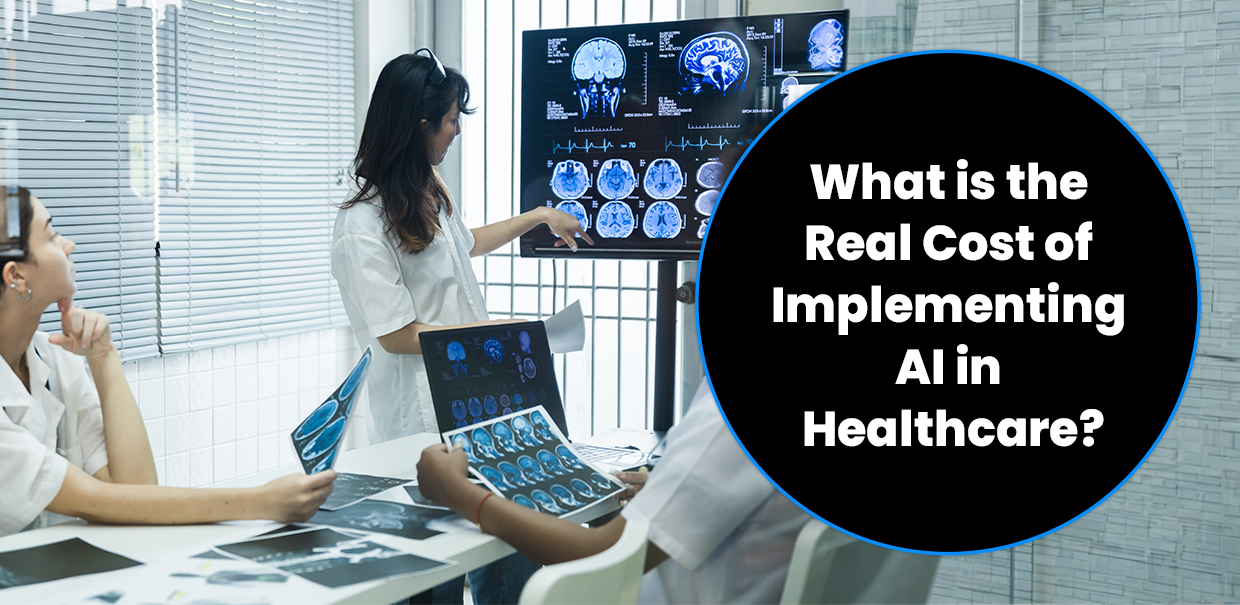
The cost of implementing AI in healthcare extends well beyond model development to include data readiness, compliance, integration, and long-term operational governance.
According to industry analyses from 2024-2025, AI implementation costs in healthcare range dramatically, from approximately $40,000 for basic AI functionality to well over $1 million for comprehensive, enterprise-scale solutions. This wide variance stems from factors including solution complexity, data infrastructure maturity, regulatory requirements, and deployment scale.
For healthcare organizations evaluating Digital Transformation initiatives, understanding the full cost spectrum of implementing AI in healthcare is essential for realistic budgeting and sustainable ROI. This analysis breaks down the major cost drivers and hidden expenses that define successful AI adoption in regulated healthcare environments.
Healthcare AI Implementation Costs by Use Case
The following table presents typical cost ranges for common healthcare AI implementations based on 2024-2025 industry benchmarks:
| AI Use Case | Cost Range | Implementation Time | Primary Cost Drivers |
|---|---|---|---|
| Virtual Health Assistants/Chatbots | $40,000 - $120,000 | 2-4 months | NLP sophistication, EHR integration |
| Revenue Cycle Automation | $70,000 - $250,000 | 3-6 months | Workflow complexity, payer-specific rules |
| Clinical Decision Support Systems | $150,000 - $600,000 | 6-12 months | Clinical validation, explainability requirements |
| Remote Patient Monitoring | $200,000 - $500,000 | 6-12 months | IoT integration, real-time analytics |
| Medical Imaging/Diagnostics AI | $300,000 - $1,000,000+ | 9-18 months | Imaging data volume, regulatory approval |
| Enterprise AI Platform | $500,000 - $1,500,000+ | 12-24 months | Multi-department integration, governance |
Sources: Signity Solutions, ITRex Group, Orangesoft
Healthcare organizations evaluating these use cases must recognize that the listed ranges represent initial implementation costs only. Ongoing operational expenses, including model retraining, infrastructure scaling, compliance updates, and maintenance, typically add 20-30% of the initial investment annually.
The cost of implementing AI in healthcare varies most significantly based on clinical criticality. AI systems supporting administrative workflows carry lower validation requirements and faster deployment timelines than clinical AI used for diagnostics or treatment decisions, which demand stricter accuracy standards and regulatory compliance.
Data Preparation
Data readiness represents one of the most underestimated cost factors in healthcare AI projects. Healthcare data preparation can account for 20-40% of the total cost of implementing AI in healthcare, yet many organizations fail to budget adequately for this foundational work.
Healthcare data exists across fragmented systems—electronic health records, imaging platforms, laboratory systems, and medical devices—often in incompatible formats. Before AI models can deliver reliable outcomes, this data must undergo extensive preparation, including extraction, normalization, labeling, de-identification, and governance framework establishment.
Data acquisition costs vary significantly based on project scope. Organizations with insufficient internal datasets may need to purchase commercial medical datasets, which can cost tens of thousands of dollars depending on data type, size, and labeling quality. Alternatively, synthetic data generation using generative AI involves licensing costs, computational resources, and human expert validation.
Data annotation represents another substantial expense, particularly for clinical AI applications. Medical experts must annotate domain-specific data like radiology scans or pathology slides, with complex annotations costing $10 or more per instance due to the clinical expertise required.
Data cleaning and preprocessing typically start at $10,000 per dataset, with costs increasing based on data volume, complexity, and quality issues. These expenses recur as organizations incorporate new data sources to improve model performance.
Infrastructure and Computing
The cost of implementing AI in healthcare scales dramatically with infrastructure requirements. Cloud computing expenses for AI workloads range from $430-$650 monthly for simple models operating on standard virtual CPUs to $5,000-$15,000 for complex generative AI models requiring high-performance tensor processing units.
For organizations choosing on-premises deployment, hardware investments start around $5,000 for simple static models but can exceed $100,000 for advanced deep learning systems with powerful TPU requirements. Healthcare organizations must also factor in power consumption, cooling, and dedicated IT staff for maintenance.
Annual cloud maintenance fees for medium-scale operations currently range from $30,000 to $100,000, while on-premise hardware for large healthcare facilities can require capital expenditures exceeding $1 million. These infrastructure costs compound when scaling from departmental pilots to enterprise-wide deployments.
Regulatory Compliance
Healthcare AI systems must comply with HIPAA, GDPR, and medical device regulations, creating substantial compliance costs that cannot be deferred or minimized. HIPAA certification alone ranges from $10,000 to over $150,000 based on organization size, infrastructure complexity, and current compliance levels.
The cost of implementing AI in healthcare includes mandatory security implementations: end-to-end encryption, access controls, audit logging, and HIPAA-compliant cloud environments. Organizations must also budget for compliance expertise—hiring specialists who understand healthcare regulations, conduct internal audits, and communicate with regulatory bodies.
Healthcare data breaches carry severe financial consequences. IBM’s 2025 Cost of a Data Breach Report found the average healthcare breach cost $7.42 million and required 279 days to contain. For 2024, the average healthcare data breach cost reached $9.77 million—making proactive compliance investment economically essential.
Validation and third-party audits cost $10,000-$50,000 per algorithm, with complex diagnostic tools requiring clinical trial data potentially exceeding $500,000 for comprehensive validation. These costs recur as organizations update AI models or expand to new clinical applications.
System Integration
Integration represents a significant cost driver when implementing AI in healthcare environments. AI systems must connect with existing electronic health records, picture archiving and communication systems, billing platforms, and medical devices—each requiring custom APIs, middleware, and interoperability protocols.
Integrating AI with existing EHR/EMR systems typically costs $7,800-$10,400 for standard configurations. However, organizations using legacy systems face substantially higher expenses, with engineers charging $25,000-$35,000 just to analyze system architecture and data formats before integration begins.
Building middleware and APIs to connect with medical devices adds at least $10,000, while user interface modifications to customize AI interaction and output display require another $10,000 or more. These integration costs compound based on the number of systems requiring connectivity and the complexity of the existing healthcare IT infrastructure.
Ongoing Operations
AI implementation is not a one-time expense. Operational costs typically represent 20-30% of the initial AI investment annually, covering model monitoring, retraining, infrastructure scaling, security updates, and evolving regulatory compliance.
Model retraining represents 25-45% of total AI implementation costs over time. As patient demographics, clinical protocols, and care patterns evolve, AI models experience performance drift requiring periodic retraining and validation. This process demands technical infrastructure—including retraining workflows, CI/CD pipelines, and data versioning systems—plus ongoing human oversight from data scientists, MLOps engineers, and clinical validators.
Regulatory updates and audits consume 10-20% of total implementation costs as healthcare organizations adjust AI programs to accommodate evolving FDA, EMA, and local health authority guidelines. These changes can trigger model revalidations, additional audit trails, and third-party validation requirements.
The cost of implementing AI in healthcare must account for infrastructure modernization, including cloud optimization, security upgrades, and platform evolution, which adds to long-term expenditure. Organizations that ignore lifecycle costs encounter one of the most common budgeting mistakes in AI initiatives.
ROI and Cost Effectiveness
Despite substantial upfront costs, AI delivers measurable return on investment through operational efficiency and improved clinical outcomes. Healthcare organizations implementing AI strategically achieve $3.20 return for every dollar invested within 14 months, according to 2025 transformation frameworks.
AI can automate up to 45% of administrative tasks in healthcare, producing annual savings of $150 billion according to McKinsey research. Automation of documentation, coding, and scheduling decreases manual effort, allowing clinicians to spend more time on patient care.
AI-assisted radiology demonstrates 10-15% increases in early-stage cancer detection, with MIT/MGH studies achieving 94% accuracy in lung nodule detection compared to a 65% human baseline. Detecting stage-I tumors versus stage-IV tumors reduces treatment costs by over $100,000 per patient.
AI-powered mobile apps for high-readmission-risk patients reduced readmissions by 48% in published research. Given that readmission costs run approximately 10% higher than initial admissions, these savings significantly offset AI implementation expenses while improving patient outcomes.
Controlling Costs of AI Implementation in Healthcare
Healthcare organizations can optimize the cost of implementing AI in healthcare through phased deployment strategies. Starting with proof-of-concept projects ranging $30,000-$60,000 allows organizations to validate feasibility, performance, and adoption before committing to full-scale implementation.
Organizations can reduce implementation costs through strategic technology choices. Leveraging MLOps to automate data pipelines, model retraining, and deployment workflows can save up to 30% in long-term maintenance and operational costs. Setting up drift detection scripts that trigger retraining only when statistically significant performance drops occur eliminates unnecessary computing expenses.
Building compliance and governance into AI system design from the outset, rather than retrofitting security measures, reduces long-term costs and regulatory risk. Organizations that treat AI as an evolving capability rather than a one-time project consistently achieve better ROI and sustainable value creation.
Contact 7T for Healthcare AI Implementation
At 7T, we’re guided by our core philosophy of “Business First, Technology Follows.” As such, the 7T development team works with company leaders who are seeking to solve problems and drive ROI through Digital Transformation and innovative technologies like AI.
7T has offices in Dallas and Houston, but our clientele spans the globe. If you’re ready to discuss your Digital Transformation project and accurately assess the cost of implementing AI in healthcare for your organization, contact 7T today.