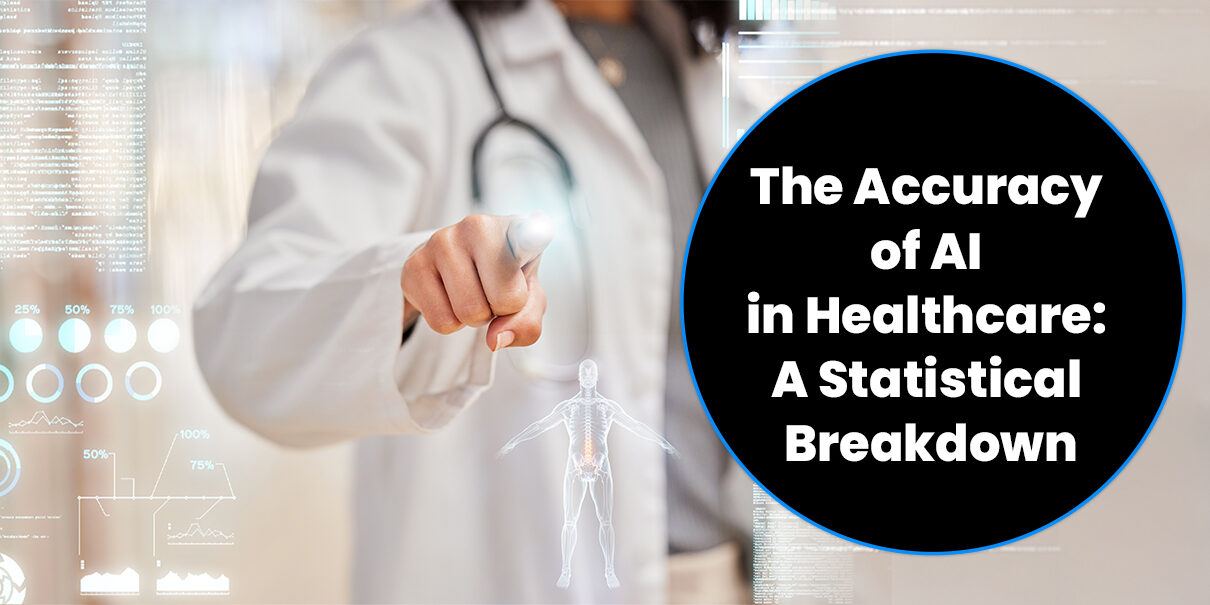
Artificial intelligence in healthcare promises revolutionary improvements in diagnostic accuracy, predictive analytics, and operational efficiency. The accuracy of AI in healthcare is reported at around 85.5%, but this often contrasts with the real-world accuracy of 52.1%. This 33-percentage-point gap demands careful examination before healthcare organizations make critical deployment decisions.
Diagnostic AI Accuracy
AI diagnostic tools demonstrate significant promise, yet their accuracy varies dramatically based on application context and deployment environment. AI diagnostic tools can exceed 95% accuracy in specific domains like lung cancer detection and retinal disease screening, but this performance depends heavily on data quality, workflow integration, and the clinical setting.
Diagnostic AI Is Less Accurate Than Specialists
A meta-analysis of 83 studies published in Nature’s npj Digital Medicine reveals a critical pattern: AI performed comparably to non-specialist physicians (p=0.93) but significantly worse than expert physicians (p=0.007). This statistical finding means there’s less than a 1% probability the performance gap occurred by chance; AI diagnostic accuracy matches generalists but consistently trails specialists.
| Application Domain | AI Accuracy | Clinical Context | Source |
|---|---|---|---|
| Lung Cancer Detection | 98.70% | CT scans with curated datasets | PMC/NIH 2025 |
| Retinal Disorder Screening | 95.20% | Diabetic retinopathy assessment | PMC/NIH 2023 |
| General Diagnostic Decision Support | 52.10% | Real-world clinical applications | Nature npj Digital Medicine 2025 |
| Breast Cancer Screening | 13.8% improvement | Mammography workflow integration | Nature Communications 2025 |
Sources: PMC/NIH 2025, PMC/NIH 2023, Nature npj Digital Medicine 2025, Nature Communications 2025
Diagnostic AI in Radiology Shows Promise
AI performs best in domains with clear imaging patterns and large training datasets. In radiology workflows, AI accuracy reached 92% for pulmonary conditions, compared to 78% for manual interpretation by clinicians, representing a 14% improvement. In pathology, AI correctly identified cancerous lesions in 85% of cases versus 75% for clinicians without AI assistance, representing a 10% improvement.
Between 76% and 81% of all FDA-cleared AI devices are radiology algorithms, with 758 radiology algorithms cleared as of early 2025. This concentration reflects both the maturity of imaging AI and the clearer pathway to validation in pattern-recognition tasks with structured data inputs
Integration Challenges and Automation Bias
A paradox emerged in JAMA research: ChatGPT Plus alone achieved 92% median diagnostic accuracy, while physicians using ChatGPT Plus achieved only 76.3% accuracy, lower than the AI operating independently. This suggests integration challenges and “automation bias,” where clinicians may over-rely on AI recommendations without adequate critical assessment, or misinterpret AI outputs in ways that reduce overall accuracy. Proper training through well-maintained data will be essential for success, meaning that data prep and maintenance is one of the key first steps for healthcare businesses looking to implement AI.
Predictive Analytics
False Positives in AI-Powered Sepsis Detection
AI-enabled sepsis detection systems can track subtle changes in vital signs and laboratory indicators, warning clinicians hours before overt manifestations occur. However, these systems also generate false positive alerts that can lead to “alarm fatigue,” reducing their practical utility when workflow integration isn’t carefully managed. So, it is vital to have a well-organized workflow that minimizes the impact of false positives by establishing quick, simple verification procedures.
Adoption and Accuracy Evaluation
Predictive AI shows measurable impact in operational healthcare settings. By 2024, 71% of U.S. hospitals had adopted predictive analytics integrated with EHRs, primarily for sepsis detection, readmission risk, and patient deterioration alerts. Yet accuracy evaluation remains inconsistent: in 2024, 82% of hospitals evaluated predictive AI for accuracy, 74% for bias, and 79% conducted post-implementation monitoring. It is absolutely vital that healthcare businesses that adopt AI tools audit them consistently for accuracy, both for their own records and to better inform the industry.
Implementation Gaps That Reduce the Accuracy of AI in Healthcare
Several factors create the gap between benchmark performance and real-world outcomes:
- Data Quality and Bias: AI models trained on incomplete or non-representative datasets produce biased recommendations. Up to 20% of fundus images are ungradable by AI systems like IDx-DR due to poor image quality, requiring manual review. In femur segmentation from DXA images, accuracy dropped from 98.84% to 89.36% when noise-reduction filters were not used during preprocessing, nearly a 10% decrease.
- Distributional Shift: AI models often experience performance declines when deployed outside their original training environment. A 2024 study in Nature Medicine found that chest X-ray models trained at a single institution exhibited up to a 20% drop in diagnostic performance when tested on external datasets. This “covariate shift” occurs when differences in imaging protocols, equipment types, or patient demographics introduce variations that the AI doesn’t generalize well across.
- Guardrails and Bias Protection: In highly regulated industries like healthcare and financial services, bias in AI models creates compliance risks. Guardrails ensure AI doesn’t make decisions that stray off path and cause regulatory violations. 7T’s approach focuses not just on accuracy but on implementing guardrails to protect private data and prevent bias from creeping into models, particularly critical for healthcare organizations that face audits and potential fines.
The Realistic Path Forward
Evidence points to a clear success pattern: AI excels at narrow, well-defined tasks with clear imaging patterns and structured data inputs. The path forward isn’t AI versus doctors; it’s AI as a specialist tool for primary care triage, imaging workflow optimization, and administrative automation.
Three deployment principles emerge to improve the accuracy of AI in healthcare:
- Start with proven applications: Imaging, administrative automation, and predictive sepsis detection show consistent real-world performance improvements.
- Validate in your context: Don’t rely on vendor benchmarks designed for teaching cases. Test performance with your actual patient population, imaging equipment, and workflow constraints.
- Ensure guardrails protect data and prevent bias: In regulated industries, compliance depends on preventing AI from making decisions that create audit risks or perpetuate existing healthcare disparities.
Harvard School of Public Health reports that AI-assisted diagnoses could lower treatment costs by up to 50% while improving patient outcomes by 40%, but these gains depend entirely on thoughtful implementation that addresses data quality, workflow integration, and bias mitigation.
Partner with 7T for Pragmatic Healthcare AI
At 7T, we’re guided by understanding where the accuracy of AI in healthcare provides improvements compared to human-only processes, versus where implementation gaps reduce real-world impact. As such, the 7T development team works with company leaders who are seeking to solve problems and drive ROI through Digital Transformation and innovative technologies like AI.
Our approach focuses on data quality, workflow integration, guardrails to protect private data, and measurable accuracy improvements rather than lab-based performance claims. We ensure AI implementations don’t just meet benchmark standards; they perform reliably in your actual clinical environment with your patient populations and regulatory requirements.
7T has offices in Dallas and Houston, but our clientele spans the globe. If you’re ready to deploy AI that performs in your actual clinical environment, contact 7T today.