Healthcare organizations face unprecedented pressure to modernize operations, reduce costs and improve patient outcomes while navigating workforce shortages and rising operational expenses. As we move into 2026, Digital Transformation powered by artificial intelligence is essential for survival in an increasingly competitive healthcare landscape.
Digital Transformation is fundamentally reshaping healthcare across all disciplines, from providers and payers to life sciences and healthcare technology companies. The convergence of AI and Digital Transformation is driving efficiencies, enabling personalized medicine, improving patient outcomes and creating a healthcare system that is proactive, predictive and patient-centric.
In this article, we’ll explore the most impactful Digital Transformation trends in healthcare going into 2026.
Agentic AI: Transforming Healthcare Payer Operations
| Payer Function | Payer Function | Payer Function |
|---|---|---|
| Claims Processing | Automated intake, verification, adjudication | Reduced processing time, fewer errors |
| Prior Authorization | GenAI-powered decision support | Faster approvals, improved provider relations |
| Member Services | 24/7 agentic AI assistants | Higher satisfaction, reduced call center strain |
| Fraud Detection | ML-driven analytics | Cost savings, improved payment integrity |
| Risk Adjustment | Predictive modeling | Better member identification, optimized care coordination |
| Utilization Management | Automated review processes | Increased efficiency, consistent decisions |
Healthcare payers face a critical challenge: roughly 60% of insured adults in the United States report experiencing problems using their health insurance within the past 12 months. With healthcare expenditures projected to reach nearly $5 trillion in 2025, representing over 18% of the U.S. gross domestic product, insurance companies must modernize their operational strategies to remain competitive.
Agentic AI represents the next evolution in artificial intelligence: autonomous AI agents that exhibit human-like behavior, operate independently using internal models and learning algorithms and require minimal human intervention. Unlike traditional AI systems or simple chatbots, agentic AI can complete complex, multi-step tasks across business functions with remarkable efficiency.
How Agentic AI Benefits Healthcare Payers
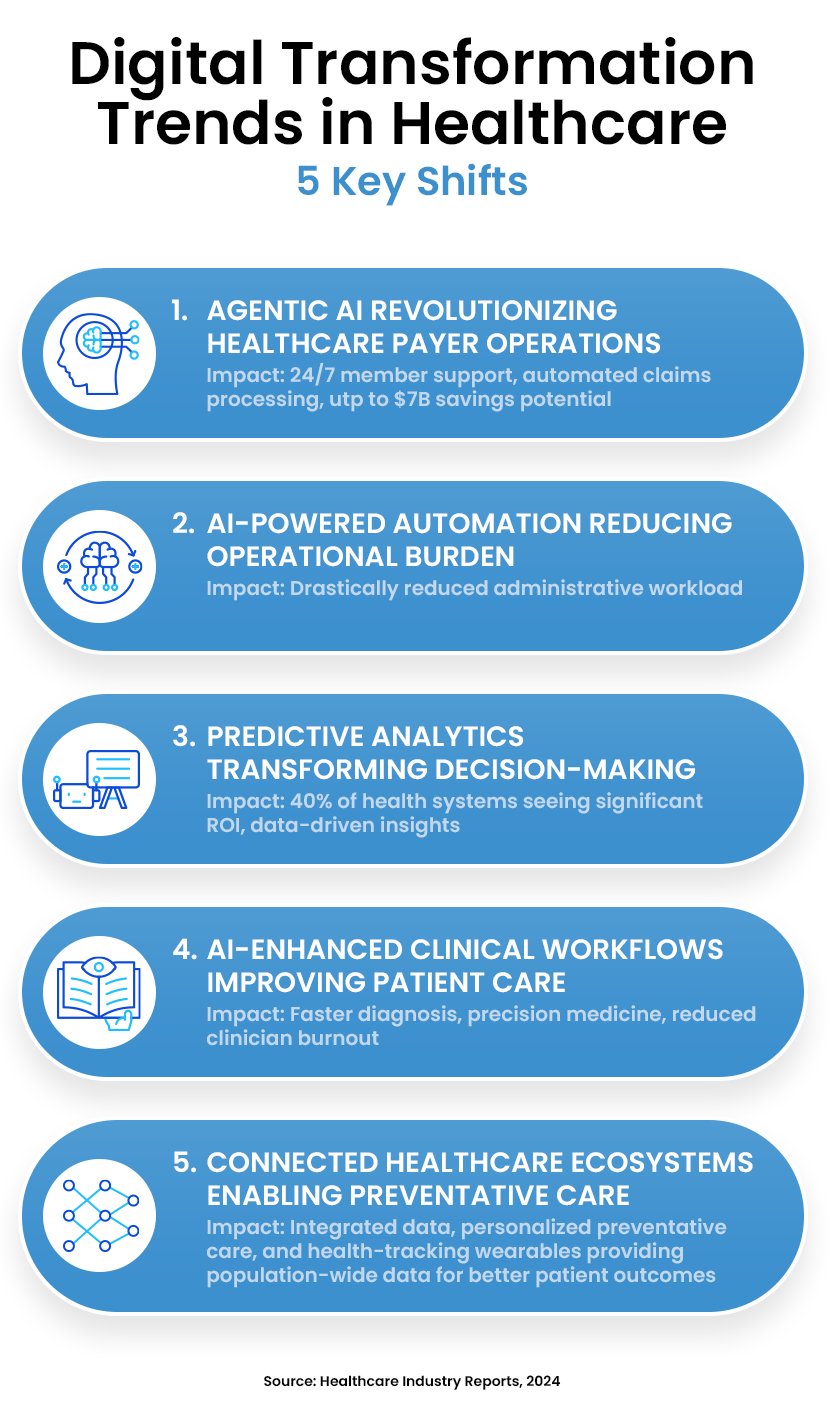
According to research by Accenture, insurers could save up to $7 billion over 18 months using AI-driven technologies by streamlining administrative processes. Agentic AI delivers specific advantages for healthcare payers:
Round-the-Clock Member Support: Agentic AI solutions provide 24/7 member support, addressing the growing demand for accessible healthcare information outside traditional business hours. Members receive immediate responses to routine inquiries about benefits, coverage and provider networks without waiting for human assistance.
Automated Claims Processing: AI agents automate intake, case summarization, verification and adjudication while embedding analytic-driven fraud, wastage and abuse detection throughout the full claims journey. This dramatically reduces processing times and improves accuracy.
Prior Authorization Streamlining: Generative AI and machine learning models are automating the complex prior authorization process, streamlining provider-payer communication and enabling faster care delivery. This addresses one of the most frustrating aspects of health plan operations.
Enhanced CAHPS Scores: Agentc AI can enhance customer service and overall member experience, and positively impact Consumer Assessment of Healthcare Providers and Systems (CAHPS) scores for payers, particularly for Medicare Advantage and Medicaid Managed Care. Improved CAHPS scores directly influence Star Ratings, which affect quality bonus payments, member enrollment, retention and plan reputation.
Multilingual Capabilities and Consistency: Leading agentic AI solutions provide support in multiple languages, improving access for diverse populations while ensuring consistent, accurate information delivery based on current benefit information and regulatory requirements.
Preventive Care: Agentic AI can continuously and securely monitor member data, spot early risk signals, and proactively trigger personalized outreach—reminders, care plans, and coordination—to prevent avoidable ER visits. By automating follow-ups and closing gaps in care caused by neglect or non-compliance, AI helps healthcare payers shift from reactive treatment to true preventive care.
AI-Driven Administrative Automation: Reducing Healthcare’s Operational Burden
Administrative tasks consume valuable resources across healthcare organizations, contributing to clinician burnout and operational inefficiencies. Research indicates that between 15% and 28% of nurses’ work consists of low-value administrative tasks, while doctors in intensive care units might spend as little as 15% to 30% of their time with patients, with the remainder dedicated to updating medical records and other administrative work.
According to Deloitte’s 2025 Global Health Care Outlook, accelerated Digital Transformation was cited as the issue most likely to impact global health systems in 2025. About 90% of surveyed C-suite executives expect the use of digital technologies to accelerate significantly in 2025.
Key Areas for Administrative AI Implementation
Claims and Billing Automation: AI automates data management in accounting departments and data capture from financial documents, saving countless hours of data entry and organization work while providing cheaper, more accurate and more quickly accessible financial information.
Clinical Documentation: Ambient clinical documentation tools (AI scribes) listen and auto-draft clinical notes, directly combating physician burnout and reducing administrative load. According to research from the Deloitte US Center for Health Solutions, technology can free up between 13% and 21% of nurses’ time, translating to 240 to 400 hours per year for a single nurse.
Scheduling and Patient Communication: Customer service automations come in modern, convenient forms like AI chatbots or more traditional forms like automated email and other communication channels, improving patient access while reducing staff burden.
Supply Chain Management: Data automation speeds and simplifies supply chain management while automating tracking and projecting future supplies based on existing inventory and outstanding orders.
Real-World Highlight
Predictive Analytics and AI-Powered Decision Intelligence
Data-driven decision-making reduces risk, improves stability and helps healthcare organizations identify and adapt to industry trends faster. More than 40% of health system executives report their organizations have already experienced significant-to-moderate returns on their investments in generative AI.
Predictive analytics leverage company data and historical trends to generate actionable insights regarding:
- Patient health trajectory and readmission risk
- Resource allocation and staffing needs
- Revenue forecasting and financial planning
- Population health management
- Treatment efficacy and outcomes prediction
Real-World Highlight
Connected Healthcare Ecosystems: From Reactive to Preventive Care
The future of healthcare lies in connected ecosystems that merge online and offline services, emphasizing preventive care alongside treatment. This integration requires close collaboration and information-sharing among patients, healthcare providers, insurers and other stakeholders.
The Shift Toward Preventive Healthcare
Insurers are playing a pivotal role by expanding preferred medical networks, providing patients with more options while enhancing claims cost visibility from the start of the care journey. Many insurers have implemented or are considering health and wellness programs that reward customers for healthier lifestyles.
By leveraging integrated health data, including electronic health records, claims history and health tracking wearables enriched with population-wide data, insurers and providers can effectively monitor health and deliver personalized product offerings. Collaboration with third-party platforms for health data analytics ensures timely access to emerging health trends.
Platform Modernization is Essential: To accelerate future-ready operations, healthcare organizations should leverage agentic AI in conjunction with platform modernization . This creates a connected healthcare ecosystem that integrates advanced AI with modern processes and strategic partnerships, enhancing decision-making and delivering consistent, timely and accurate outcomes.
Clinical AI: Enhancing Provider Capabilities
On the clinical side, AI is augmenting provider capabilities in remarkable ways. Algorithms that assist in analyzing CT scans, MRIs and X-rays represent more than three-quarters of AI-based devices authorized by the US Food and Drug Administration.
AI-powered clinical decision support systems analyze multimodal patient data, including genomics and medical history, to offer real-time, evidence-based recommendations for personalized care. This precision diagnostics capability enables providers to classify medical images with greater speed and accuracy, resulting in improved patient outcomes.
The Future is Now: Embracing Digital Transformation
The integration of AI in healthcare is not just a technological advancement but a fundamental shift toward a more proactive and innovative healthcare system. Organizations that modernize platforms and leverage the capabilities of AI can significantly enhance experiences, reduce processing times and minimize errors.
As the healthcare landscape continues to evolve, organizations that prioritize these strategic changes will be better positioned to meet the needs of stakeholders and thrive in a competitive market. The emphasis on preventive care and the seamless merging of online and offline health services can lead to better health outcomes and reduced costs for all participants in the healthcare ecosystem.
Implement Digital Transformation Trends in Healthcare With 7T
At 7T, we’re guided by our “Business First, Technology Follows” philosophy. As such, the 7T development team works with healthcare leaders who are seeking to solve problems and drive ROI through Digital Transformation and innovative technologies like AI.
7T has offices in Dallas and Houston, but our clientele spans the globe. If you’re ready to capitalize on Digital Transformation trends in healthcare, contact 7T today.