Custom software development in 2026 looks fundamentally different from just two years ago. AI integration, cloud-native architecture, and structured discovery processes have moved from differentiators to baseline expectations. For company leaders evaluating their next technology investment, understanding the trends in custom software development shaping this cycle is the first step toward making decisions that generate a measurable return.
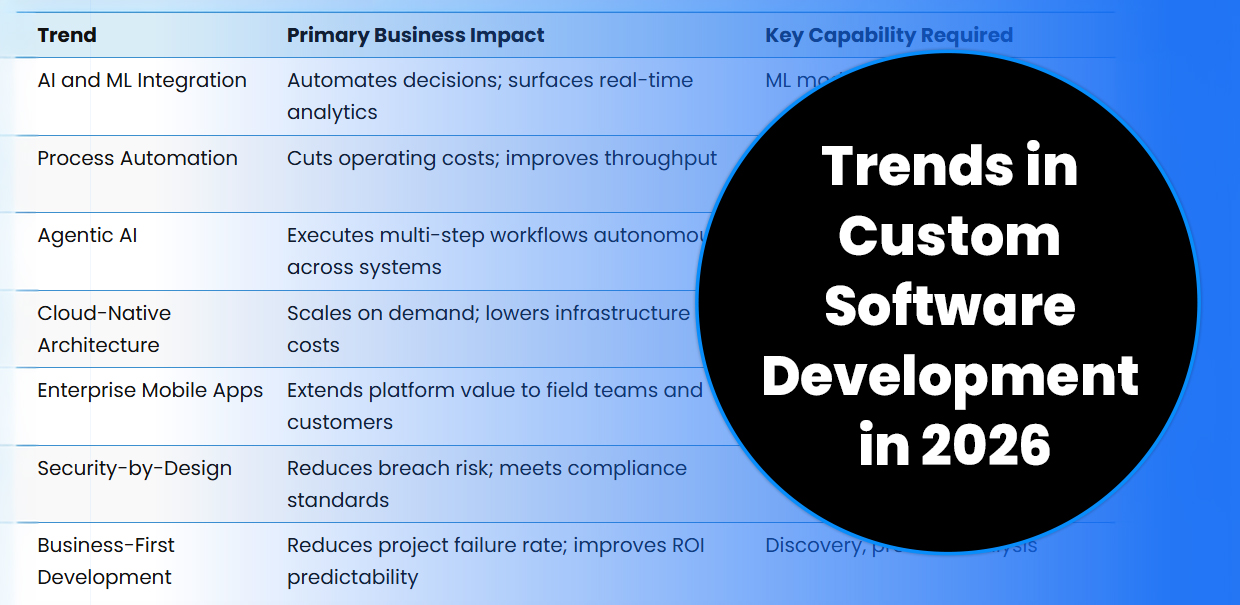
2026 Trends in Custom Software Development
| Trend | Primary Business Impact | Key Capability Required |
|---|---|---|
| AI and ML Integration | Automates decisions; surfaces real-time analytics | ML models, LLM development |
| Process Automation | Cuts operating costs; improves throughput | RPA, API integration, workflow design |
| Agentic AI | Executes multi-step workflows autonomously across systems | Agent orchestration, governance frameworks |
| Cloud-Native Architecture | Scales on demand; lowers infrastructure costs | DevOps, multi-cloud deployment |
| Enterprise Mobile Apps | Extends platform value to field teams and customers | iOS, Android, cross-platform dev |
| Security-by-Design | Reduces breach risk; meets compliance standards | HIPAA, SOC 2, PCI-DSS |
| Business-First Development | Reduces project failure rate; improves ROI predictability | Discovery, process analysis |
AI and ML Integration Is Now a Core Component of Custom Software
Generative AI has moved beyond standalone chatbots. In 2026, organizations are embedding AI capabilities directly into their custom platforms, from intelligent document processing and predictive analytics to machine-learning-powered employee performance tools. According to Gartner, worldwide IT spending is expected to total $6.08 trillion in 2026, a 9.8% increase from 2025, with AI features now embedded across enterprise software as a primary cost driver.
The highest-ROI implementations treat AI as a foundational layer, not an add-on. Projects that integrate AI into platform architecture from the start, rather than retrofitting it later, deliver more consistent results and scale more predictably. The decision between custom ML models, commercial frameworks such as OpenAI or IBM WatsonX, or a hybrid approach depends on the nature of the data and the specificity of the business problem being solved.
| AI Integration Approach | Best For | Typical Outcome |
|---|---|---|
| Custom ML models | Proprietary data, unique processes | Higher accuracy, longer build time |
| Commercial LLM implementation | NLP, content and communication workflows | Faster deployment, lower model cost |
| Hybrid (custom + commercial) | Complex enterprise use cases | Highest flexibility and ROI |
| No AI layer | Simple transactional tools | Lower upfront cost, limited long-term value |
Not all custom software developers offer AI and ML integration, and many offer it with limited expertise. Business leaders should consider the AI/ML experience of a development partner before entering a development agreement to avoid common implementation issues.
Agentic AI Is Redefining What Enterprise Software Can Do Autonomously
From the outset, AI was largely utilized as a process automation tool. Even in 2026, process automation is one of the most common triggers for new custom software engagements, particularly among mid-market companies with revenues between $10 million and $500 million.
Effective automation projects require software that integrates with existing ERPs, CRMs, and third-party APIs, rather than off-the-shelf tools that only partially address the problem. The design goal is not simply to automate a task but to re-engineer the underlying process around the capabilities automation enables.
| Automation Type | Common Problem Solved | Primary Value |
|---|---|---|
| Document processing | Manual data entry and transcription errors | Significant reduction in manual data-entry time |
| Approval workflows | Slow, multi-step decision cycles | Compressed timelines; fewer handoff bottlenecks |
| Reporting and analytics | Spreadsheet-dependent, reactive reporting | Real-time data access for leadership |
| Customer-facing workflows | High support volume, slow resolution times | Measurable reduction in ticket backlog |
Unlike standard AI integrations that respond to individual prompts, agentic AI systems plan, execute, and adapt across multi-step workflows with minimal human intervention. These systems operate across platforms, make decisions based on real-time data, and complete complex tasks end-to-end, representing a fundamentally different layer of capability than what most enterprises have deployed to date. According to Gartner, 40% of enterprise applications are expected to include task-specific AI agents by the end of 2026, up from less than 5% in 2025.
Enterprise investment reflects the confidence in this shift. According to Fortune Business Insights, the global agentic AI market is projected to grow from $9.14 billion in 2026 to $139.19 billion by 2034, at a CAGR of 40.50%. For custom software projects, this means organizations are increasingly evaluating whether their platforms can support autonomous workflow execution that goes beyond scripted automation into genuinely adaptive operation.
| Agentic AI Enterprise Adoption Metric | Finding |
|---|---|
| Enterprise apps to include task-specific AI agents by end of 2026 | 40% (up from <5% in 2025) |
| Senior executives planning to increase AI budgets due to agentic AI | 88% |
| Organizations already adopting AI agents | 79% |
| Organizations reporting productivity gains from AI agent adoption | 66% |
| Organizations reporting cost savings from AI agents | 57% |
| Global agentic AI market size in 2026 | $9.14 billion |
| Projected global agentic AI market size by 2034 | $139.19 billion |
| Market CAGR (2026-2034) | 40.50% |
Sources: Gartner, “Gartner Predicts 40% of Enterprise Apps Will Feature Task-Specific AI Agents by 2026,” August 2025; PwC, “AI Agent Survey,” May 2025; Fortune Business Insights, “Agentic AI Market Size, Share & Industry Analysis,” updated June 2026
The pace of adoption makes it important to distinguish between development partners who are actively building with agentic frameworks and those who are simply using the terminology. Reviewing a partner’s AI strategy capabilities before a project begins can reveal whether they have the governance and scoping experience needed to deploy autonomous agents responsibly.
Cloud-Native Architecture Is the New Default for Enterprise Platforms
Custom software built without cloud-native architecture is increasingly difficult to scale, expensive to maintain, and harder to secure. Cloud-native design, including containerization, microservices, and multi-cloud deployment, has become the standard approach for enterprise-grade platforms in 2026. According to Precedence Research, the global custom software development market is projected to grow from $53.02 billion in 2025 to $388.76 billion by 2035, with the cloud infrastructure segment holding 58% of market deployments as of 2025.
Organizations that adopt cloud-native architecture eliminate upfront hardware costs, scale resources based on actual usage, and build redundancy into their systems from day one. Hybrid and multi-cloud setups have also become the norm for enterprises seeking to avoid vendor lock-in and maintain operational resilience.
| Architecture Type | Scalability | Long-Term Maintenance Cost | Best For |
|---|---|---|---|
| Cloud-native (microservices) | High | Lower | Enterprise platforms, SaaS products |
| Traditional monolithic | Low | Higher | Simple, low-traffic applications |
| Hybrid (cloud + on-premises) | Medium | Variable | Legacy system modernization |
Cloud-native platforms deliver the most value when integrations are architected from the start rather than added later. Development teams with experience in enterprise integration can ensure cloud systems connect cleanly with existing ERPs, CRMs, and third-party tools without costly retrofits down the line.
Enterprise Mobile Apps Remain a High-Value Component of Digital Initiatives
As of late 2025, mobile devices account for 53.52% of global platform usage, per StatCounter data cited by Itransition. According to Fortune Business Insights, the global mobile application market is projected to grow from $330.02 billion in 2026 to $1,017.18 billion by 2034, at a CAGR of 15.1%. For mid-market and enterprise organizations, custom mobile applications have become standard extensions of broader digital transformation strategies rather than standalone projects.
The most effective mobile projects connect to back-office systems, support field operations or customer-facing workflows, and are built as part of a unified platform strategy. Completing UI/UX design for custom software with client approval before any code is written reduces costly rework and ensures applications consistently meet user expectations at launch.
| Mobile Application Type | Common Use Case | Primary Value |
|---|---|---|
| Enterprise mobile app | Field operations, internal tooling | Real-time data access for distributed teams |
| Customer-facing app | SaaS platform extension, consumer engagement | Increased reach and user retention |
| Companion app | Extends enterprise web platform to mobile | Consistent UX across all devices |
| IoT-connected app | Logistics, healthcare monitoring | Operational visibility at scale |
Sources: Itransition / StatCounter, “Software Development Statistics for 2026,” February 2026; Fortune Business Insights, “Mobile Application Market Size, Share & Industry Analysis,” updated June 2026.
Mobile apps that operate as standalone tools provide limited value compared to those with back-office connectivity. Evaluating a development partner’s ERP and CRM integration capabilities can help determine whether they’re equipped to build the platform connections a mobile application requires to drive real operational impact.
Business-Strategy-First Development Reduces the Risk of Building the Wrong Thing
The most persistent risk in any custom software project is building software that functions technically but fails to address the root cause of the business problem. Organizations that skip structured discovery and business analysis frequently invest significant resources only to find the resulting platform misaligned with operational needs.
Projects that begin with on-site process reviews, detailed requirements gathering, and clear definitions of expected business outcomes produce more predictable results. This front-end investment also enables fixed-cost delivery, as well-defined requirements make the scope more controllable. It gives leadership a foundation for evaluating ROI before development begins, rather than hoping for it after delivery.
| Development Approach | Project Risk | ROI Predictability | Fixed-Cost Feasibility |
|---|---|---|---|
| Strategy-first (business analysis, then solution) | Low | High | Yes |
| Technology-first (build, then find use case) | High | Low | No |
| Partial discovery | Medium | Medium | Sometimes |
Reviewing a potential partner’s development process before signing an agreement can clarify whether business analysis is a genuine priority or treated as a formality.
Capitalize on 2026 Trends in Custom Software Development with 7T
The top trends in custom software development in 2026 share one common requirement: clear business objectives. AI development, cloud-native architecture, process automation, and enterprise mobile apps each have the potential to deliver substantial returns. The organizations that achieve consistent results treat software development as a business strategy initiative, not just a technology project.
At 7T, we’re guided by a commitment to solving real business problems through technology. The 7T development team works with company leaders to drive ROI through Digital Transformation and innovative technologies such as AI.
7T has offices in Dallas and Houston, but our clientele spans the globe. If you’re ready to discuss your next software project, contact 7T today.