Most enterprise customer service teams have now run an AI agent pilot, but very few have made it work at scale. 64% of enterprise CX teams ran an agentic AI pilot in 2026, per Gartner CX research, but only 27% had a channel in full production. That gap is not explained by model quality or vendor selection. It is explained by integration depth: whether the agent can actually reach the systems it needs to resolve an issue end-to-end.
The financial case for closing that gap is straightforward. AI resolutions average $0.62 per chat ticket and $1.18 for voice against a human-agent average of $7.40, per McKinsey AI in Customer Service 2026. The teams achieving 65 to 80% deflection rates are not running a more advanced model than those stuck at 40%. They built a more complete system. This article explains what that system looks like and what it takes to build one.
In this article:
- 2026 performance benchmarks by agent type: deflection rate, CSAT, and cost
- The ROI math behind AI customer service investments
- Which customer requests AI handles well and which it does not
- Why hybrid AI-and-human models are the 2026 production standard
- What separates custom-built agents from off-the-shelf platforms
Where the Benchmarks Stand in 2026
Before getting into what separates high performers from the rest, here is where performance lands across the five main agent configurations in 2026.
| Agent Type | Cost / Resolution | Median Deflection | Average CSAT | Avg. Resolution Time | Best For |
|---|---|---|---|---|---|
| Rule-based chatbot | $0.10–$0.25 | 15–25% | 3.2/5 | 2–4 min | FAQs, simple routing |
| LLM-powered AI agent | $0.62–$1.18 | 40–58% | 4.1/5 | 1.9 min | Tier-1 mixed inquiries |
| Agentic AI (action-capable) | $0.99–$2.00 | 55–70% | 4.2/5 | 1.5 min | End-to-end resolution |
| Hybrid AI + human escalation | $1.50–$3.50 | 65–80% | 4.25/5 | 2.1 min | Complex service environments |
| Human agent only (baseline) | $6.00–$12.00 | N/A | 4.3/5 | 8–12 min | Disputes, complaints |
Sources: Digital Applied | Fin.ai
Two things stand out. First, the cost advantage is decisive at every AI tier. Second, the CSAT gap is nearly closed: pure-AI handling scores 4.1/5, compared with 4.3/5 for human agents, and hybrid escalation flows narrow that gap to just 0.05 points, per Intercom Customer Service Trends 2026. The quality objection to AI customer service has been effectively addressed. What remains is execution.
Architecture Sets Your Ceiling
The architecture you choose determines not just where you start, but how high your deflection rate can go. There are three meaningfully different tiers.
Rule-based chatbots follow decision trees written by humans. They are fast to deploy but cap out at 15-25% deflection because any query outside the predefined flow triggers an escalation. LLM-powered agents interpret variable intent from a connected knowledge base and reach a median deflection of 41.2%, with a top quartile at 58.7%, per Zendesk CX Trends 2026 and Salesforce State of Service 2026. They handle reformulations and off-script queries well. What they do not do is act.
Agentic AI is where the ceiling rises. These systems interpret intent and then take action: initiating refunds, updating account records, processing subscription changes, and completing transactions inside a single conversation without human involvement. Voice-AI, one application of this model, now handles 19% of inbound contact-center volume in 2026, up from 6% in 2024, per Forrester Wave research. Gartner predicts that by 2029, agentic AI will autonomously resolve 80% of common customer service issues, reducing operational costs by 30%.
The critical implication: the move from LLM agent to agentic AI is not a model upgrade. It is a system integration project. Every action the agent can take requires a secure, live connection to the back-end system holding the relevant data. That is where most off-the-shelf platforms hit their ceiling.
The ROI Math That Makes the Case
Once the architecture question is settled, the financial case for moving forward is consistent across deployment sizes. AI customer service ROI compounds: 41% in year one, 87% in year two, and exceeding 124% by year three, per Fin.ai, as systems learn from real interactions and knowledge bases mature.
Three cost categories drive the return. Direct savings are the most immediate: a team managing 50,000 conversations per month at a 67% AI resolution rate generates annual savings exceeding $2 million at $0.99 per resolution versus $8.00 per human-handled ticket. Revenue protection compounds on top of that: customers are 2.4 times more loyal when issues resolve quickly, and businesses report a 15% decrease in turnover on average. Operational scale is the third lever: redirecting 70% of volume to AI reduces a $350,000 annual team’s equivalent labor cost to approximately $120,000.
One variable matters more than any other in making these numbers real: the vendor pricing model. For a business handling 100,000 monthly conversations, per-resolution pricing at $0.99 costs $66,330 per month. Per-conversation pricing at $2.00 on the same volume costs $200,000, a difference exceeding $1.6 million annually. The pricing model you choose is often a larger ROI driver than the underlying technology.
AI Handles Some Requests Better Than Others
Knowing the architecture and the ROI model is not enough on its own. Where you deploy AI first determines how quickly the numbers materialize, because performance varies sharply depending on the type of request.
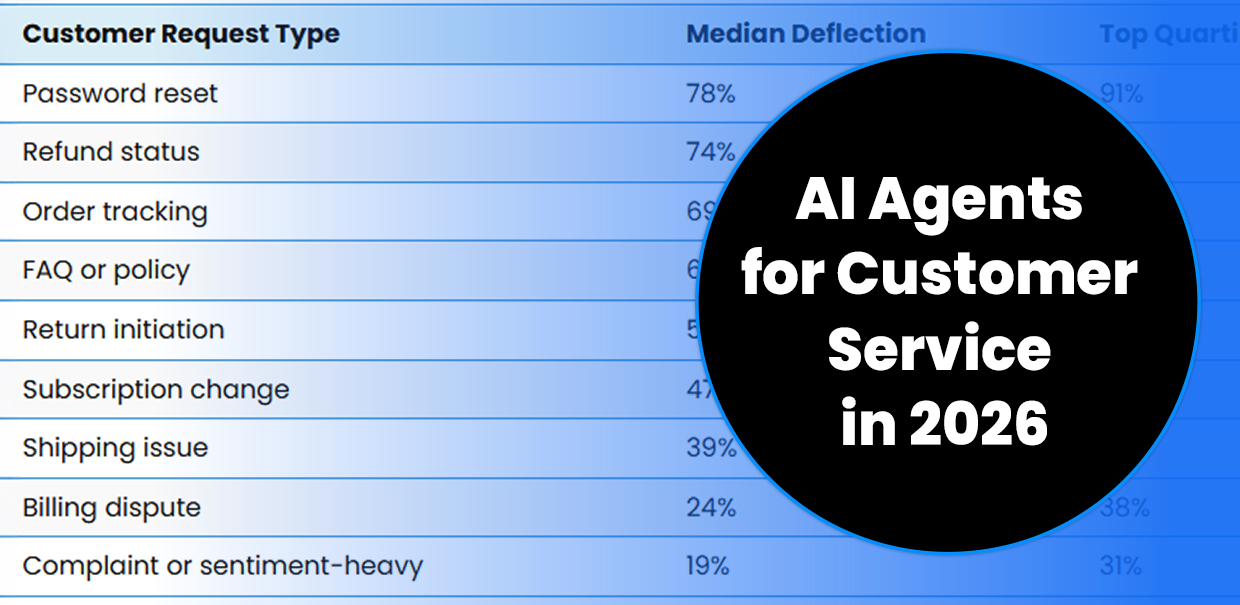
The 2026 enterprise median deflection rate is 41.2% in aggregate, but that number flattens a sharp split. Simple, lookup-based requests deflect at 65 to 80%. Anything involving negotiation, judgment, or customer frustration rarely breaks 25%.
| Customer Request Type | Median Deflection | Top Quartile | Avg. Resolution Time |
|---|---|---|---|
| Password reset | 78% | 91% | 0.6 min |
| Refund status | 74% | 87% | 1.1 min |
| Order tracking | 69% | 83% | 0.9 min |
| FAQ or policy | 66% | 81% | 1.4 min |
| Return initiation | 52% | 71% | 2.3 min |
| Subscription change | 47% | 68% | 2.7 min |
| Shipping issue | 39% | 58% | 3.4 min |
| Billing dispute | 24% | 38% | 4.7 min |
| Complaint or sentiment-heavy | 19% | 31% | 5.6 min |
Source: Digital Applied
The practical implication: build your initial deployment around the high-deflection request types. Password resets, refund status checks, and order tracking alone carry 65 to 78% deflection rates, generating fast payback while the harder categories are addressed in a second phase. Programs reporting aggregate deflection above 70% typically exclude the hard categories at triage, or count article views as resolutions. When evaluating vendor claims, ask specifically which request types are in scope.
Why Hybrid Is the Production Standard
This performance gap across request types is also why pure-AI deployments remain rare in production. Only 27% of enterprise teams had a channel fully live in 2026 despite 64% running pilots, per Gartner CX research, because complaint and dispute requests require human judgment to resolve without damaging the customer relationship.
The 2026 answer is to design for hybrid from the start instead of simply waiting for AI to get better at handling these tasks: AI handles high-confidence, high-volume, structured requests autonomously and anything below a confidence threshold routes to a human agent with full conversation context already populated. This design is what produces post-escalation CSAT of 4.30/5, nearly identical to pure-human handling at 4.34/5, per Intercom Customer Service Trends 2026 and Bain and Company.
Accuracy governance fits into this same design. Hallucination-related complaints account for 0.34% of AI-handled tickets but drop to 0.11% when retrieval-augmented generation grounds the agent’s responses against a verified knowledge base, per Ada and Forethought benchmarks. Grounding is not optional for production deployments; it is the mechanism that keeps hallucination rates in the tolerable range.
Build or Buy: The Integration Question
Gartner predicts 40% of enterprise applications will feature task-specific AI agents by end of 2026, up from less than 5% at the start of the year. Most of that first wave is landing on off-the-shelf platforms. The table below shows where the two paths diverge.
| Off-the-Shelf Platform | Custom-Built Agent | |
|---|---|---|
| Time to first deployment | 6–12 weeks | 4–9 months |
| Integration with proprietary systems | Limited to supported APIs | Full system access |
| Escalation policy control | Preset options | Fully configurable |
| Training data ownership | Vendor-shared | Fully retained |
| Pricing model | Per seat or per conversation | Project-based or retainer |
| Scalability ceiling | Vendor roadmap | Architecture-determined |
| Knowledge base control | Platform-managed | Internally owned |
Sources: Digital Applied | Fin.ai
For teams with standard CRM integrations and common request categories, off-the-shelf is a reasonable starting point. The limit appears when integration depth matters. Organizations with proprietary order-management systems, industry-specific compliance requirements, or custom data architectures regularly hit the ceiling of what packaged solutions expose through their APIs. At that point, a custom-built agent is not a luxury; it is the only way to reach the data the agent needs to actually resolve issues rather than just route them.
This is where front-end business analysis pays off more than any technology decision. The teams hitting 65 to 80% deflection rates built their knowledge base around how customers phrase questions, not how the internal team documents answers, and integrated into the systems where resolution data lives. That work happens before deployment. It is what separates a 40% deflection rate from a 70% one.
Get the Right AI Agent for Customer Service with 7T
The AI customer service benchmarks are consistent, and they demonstrate a clear investment opportunity for those who deploy it strategically. The teams that realize it are not the ones that chose the best model; they are the ones that built the most complete system: right architecture, right request prioritization, hybrid escalation design, a grounded knowledge base, and deep integration with the systems that hold resolution data. Every one of those decisions happens before deployment, not after.
7T builds custom AI agents and the back-end integrations that make them perform. For teams working out where to start and how to build the internal ROI case, 7T’s AI strategy consulting maps your specific request categories to realistic deflection targets before a platform decision is made. From there, 7T’s enterprise integration services connect your agent to the CRM, order management, and proprietary data systems that actually hold resolution data, not just the APIs a packaged platform exposes. The full build (knowledge base design, hybrid escalation logic, and system integration) is delivered through 7T’s custom software development practice, with the process starting from a thorough understanding of your business operations before a line of code is written, ensuring deflection rates that justify the investment are built in from the start.
Schedule a Consultation with 7T to discuss building a custom AI agent for your customer service operations.