At 7T, the work doesn’t end at launch. Every custom CRM, ERP, or enterprise platform we deliver eventually meets real users, and what happens in that moment determines whether the investment holds. Support is the last mile of digital transformation, and most enterprises are still getting it wrong.
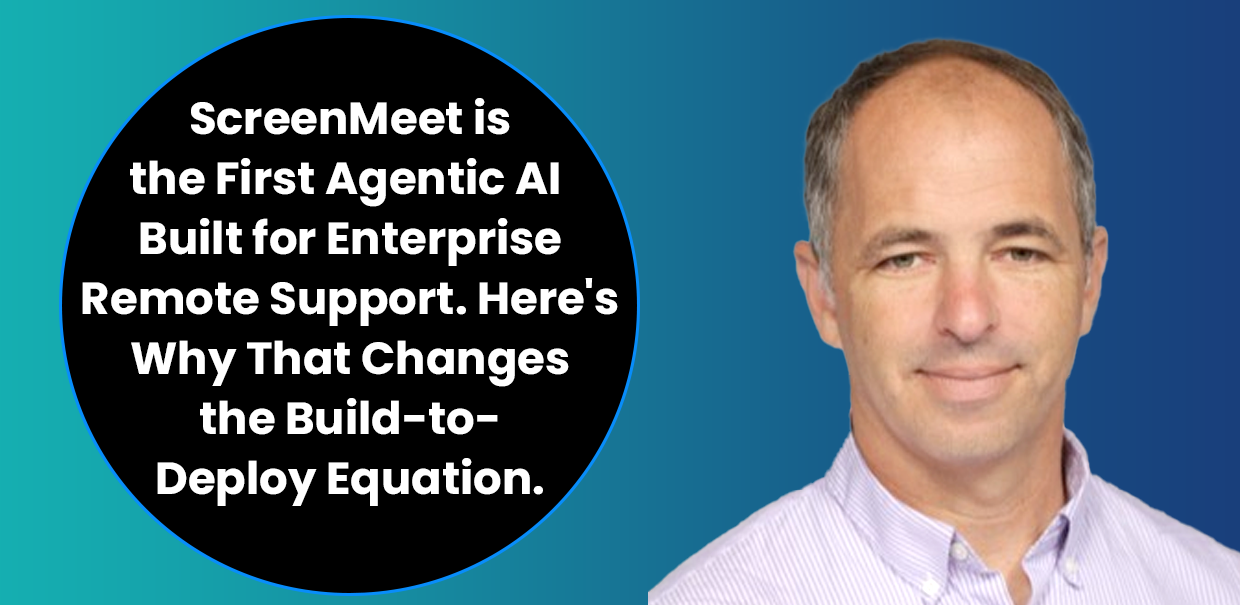
Ben Lilienthal has spent decades solving exactly that problem. As CEO and cofounder of ScreenMeet, the first agentic AI built for enterprise remote support, Ben brings a track record of founding four companies and achieving two successful exits to public companies. We sat down with him to talk about where enterprise support breaks down, what agentic AI actually fixes, and why the best time to embed intelligent support is at the start of a deployment, not after the tickets pile up.
Q: Why does enterprise support fail so consistently after a new platform goes live?
Ben: It’s a design omission. Teams spend months getting the platform right, then treat support as an afterthought. The moment users hit friction, which they always do, there’s nothing smart in place to catch them. Adoption stalls, tickets spike, and the ROI case starts to crack. The platform didn’t fail. The support layer did.
Q: What makes agentic AI different from the remote support tools enterprises are already running
Ben: Legacy tools put a human in the loop for everything. Agentic AI acts. It navigates the user’s session, identifies the issue, and resolves it autonomously, without an agent watching over it. That’s why ScreenMeet is the first agentic AI built for enterprise remote support, not just a smarter version of screen share. The category is different, and the outcomes reflect that: faster resolutions, higher containment rates, and support teams that can finally scale without adding headcount.
Q: 7T builds platforms where multiple systems talk to each other. How does ScreenMeet operate inside that kind of integrated environment?
Ben: That’s actually where it performs best. When an issue surfaces in one system but the root cause lives in another, traditional support tools go blind. ScreenMeet pulls session context across the integrated environment, so the AI or the technician sees the full picture, not just the screen the user is staring at. For the fragmented enterprise stacks 7T is built to unify, that cross-system visibility is the difference between resolving the problem and escalating it.
Q: Where does support fit in a business-first approach to AI, the way 7T thinks about it?
Ben: : It’s where AI has to prove itself with real numbers. Resolution time, first-contact resolution rate, cost per ticket. Those are concrete. When we say ScreenMeet is the first agentic AI built for enterprise remote support, we’re not making a product category claim. The system was designed to move those metrics, and enterprises deploying it are seeing that it does. Business-first AI means nothing if you can’t measure the outcome.
Q: If a company is working with 7T on a new platform build, when should ScreenMeet be part of the conversation?
Ben: : At the architecture stage, not after go-live. The AI learns from every session it runs. An enterprise that embeds ScreenMeet from day one builds months of platform-specific training data before a competitor even starts. That compounds directly into faster autonomous resolutions and a better user experience over time. Teams that treat intelligent support as a launch component, not a fix applied later, get the most out of what they build.
Ben Lilienthal is the CEO and cofounder of ScreenMeet, the first agentic AI built for enterprise remote support. A serial entrepreneur with four companies founded and two successful exits to public companies, Ben brings decades of experience in collaboration technology and enterprise software. ScreenMeet embeds natively into custom platforms, CRMs, ERPs, Salesforce, and ServiceNow, enabling enterprises to resolve support issues autonomously at scale. Learn more at screenmeet.com