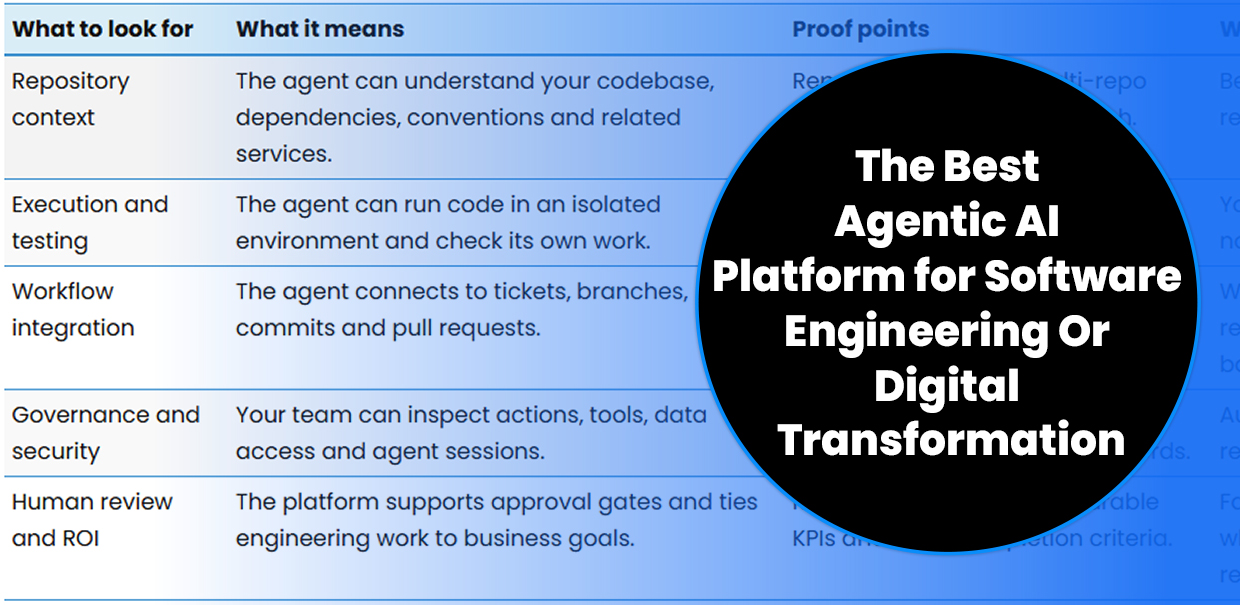
If you are searching for the best agentic AI platform for software engineering, start with the workflow, not the model. A useful platform should understand your repository, complete bounded tasks, run checks and show its work. It should also fit your review process. Your choice depends on whether your team values GitHub automation, parallel cloud work, IDE depth, issue-to-PR flow or enterprise controls.
Identifying the Best Agentic AI Platform for Software Development : At a Glance
| What to look for | What it means | Proof points | Why it matters |
|---|---|---|---|
| Repository context | The agent can understand your codebase, dependencies, conventions and related services. | Repository research, multi-repo support or a knowledge graph. | Better context can reduce rework and conflicting changes. |
| Execution and testing | The agent can run code in an isolated environment and check its own work. | Tests, linters, type checks, builds and test output. | You can judge working software, not just generated code. |
| Workflow integration | The agent connects to tickets, branches, commits and pull requests. | Issue links, branch history, diffs and approval steps. | Work stays traceable, reviewable and easier to roll back. |
| Governance and security | Your team can inspect actions, tools, data access and agent sessions. | Session logs, sandbox controls, secrets handling and audit records. | Autonomy can grow without removing oversight. |
| Human review and ROI | The platform supports approval gates and ties engineering work to business goals. | Review checkpoints, measurable KPIs and clear completion criteria. | Faster delivery matters only when it improves business results. |
Sources for this table: GitHub’s cloud-agent workflow, Cursor’s cloud-agent documentation, OpenAI’s Codex documentation, GitLab’s Agent Platform documentation, Devin’s documentation and the 2025 DORA research.
What the Best Agentic AI Platform for Software Engineering Must Do
A strong coding agent does more than produce plausible code. It should make the path from request to reviewed change shorter, clearer and safer.
| Capability | Question to ask | Why it matters | Proof to request |
|---|---|---|---|
| Repository context | Can it map dependencies, conventions and related services? | Agents need the full system picture before editing code. | Repository research, multi-repo support or a knowledge graph. |
| Execution | Can it run the project in an isolated environment? | Generated code has value only when it can be tested against the real stack. | Tests, linters, type checks and build output. |
| Workflow fit | Can it connect to tickets, branches and pull requests? | Traceable work is easier to review, assign and roll back. | Issue links, branch history, diffs and approval steps. |
| Governance | Can your team inspect actions, tools and data access? | Logs and human approval help control risk as autonomy increases. | Session history, sandbox controls, secrets handling and audit records. |
Sources for this table: GitHub’s cloud-agent workflow, Cursor’s cloud-agent documentation, OpenAI’s Codex documentation, GitLab’s Agent Platform documentation and the 2025 DORA research.
Governance deserves the highest level of attention. DORA’s 2025 research says AI amplifies an organization’s strengths and weaknesses. A weak backlog, poor tests or unclear ownership can make an agentic rollout worse. Choose a platform that exposes and improves your delivery system.
Choose by Software Context, Not by a Leaderboard
The best agentic AI platform for software engineering is the one that matches the work your team already knows how to manage.
| Your context | Platforms to evaluate | Why they may fit | Proof to validate |
|---|---|---|---|
| GitHub is the system of record | GitHub Copilot cloud agent or Codex | Both support cloud-based coding work with reviewable changes. | Issue-to-branch flow, test evidence and pull-request review. |
| Work spans repositories and services | Cursor Cloud Agents or GitLab Duo | Both emphasize broader development context and connected workflows. | Multi-repo changes, integrations and traceable agent sessions. |
| You need an autonomous engineering resource | Devin or Codex | Both support delegated engineering tasks with visible execution. | Clear task boundaries, completion criteria and human takeover. |
| You are building a new internal tool or product | Replit Agent or a custom 7T implementation | Replit can accelerate early builds; 7T can connect production software to business goals. | Planning quality, infrastructure setup, integrations and production controls. |
| You need a broader Digital Transformation | 7T’s AI agent development services alongside a platform shortlist | 7T can help with business strategy, custom development, integration, guardrails and deployment. | Business case, architecture, ROI measures and lifecycle support. |
Sources for this table: GitHub Docs, OpenAI Codex, Cursor Docs, GitLab Docs, Devin Docs, Replit Agent documentation and 7T’s AI agent development services.
Do not treat this table as a permanent ranking. Platforms change quickly. Model quality shifts, and your repository may favor one tool. Run the same task through two or three finalists. Compare planning quality, test coverage, review effort, security controls and the final diff.
Why Business Context Still Determines the Result
An agent can speed up implementation. It cannot decide which process should change, which users matter most or how success affects revenue. Make those decisions in the business case, architecture and product strategy. Do this before the first prompt reaches a coding agent.
That is where 7T’s business-first development process adds value. Its discovery work examines pain points, stakeholders, processes, integrations and requirements before solution design. Its AI agent development services extend that work into guardrails, deployment and lifecycle management.
A practical rollout looks like this:
- Define the business outcome and the engineering task it supports.
- Give the agent a controlled repository, test suite and explicit completion criteria.
- Require human review for architecture, security, data access and production changes.
- Measure cycle time, escaped defects, review effort and business results together.
7T also applies this reasoning to custom software product engineering. AI and automation must support the operating model, not sit beside it. That is the difference between adding a coding tool and improving software delivery.
Deploy Custom-Tailored AI / Digital Transformation Solutions with 7T
At 7T, we’re guided by “Business First, Technology Follows.” The best agentic AI platform for software engineering is valuable only when it supports a clear business case, integrates with your existing systems and produces measurable ROI. Through AI agent development, custom software product engineering, enterprise integration and cloud capabilities, 7T helps organizations evaluate, build and deploy AI-enabled software solutions that fit their operations.
Whether you need to augment an engineering team, modernize a software product or advance a broader Digital Transformation initiative, 7T brings business strategy, technical architecture and delivery together before development begins. If you’re ready to discuss how agentic AI can improve software delivery and support your business goals, contact 7T today.