An application can operate without issue while quietly holding a business back. Manual workarounds, slow releases, brittle integrations, outdated interfaces and limited technical expertise can make routine changes costly and risky. Over time, teams may waste more effort and money maintaining legacy systems than it would take to drastically improve the customer or employee experience.
That creates a harder decision than whether to modernize, because business leaders must determine how much to change without disrupting revenue-producing operations. Moving an application to the cloud may solve hosting problems, but may leave core workflow issues untouched. A full rebuild may create a stronger foundation, but it can also require major investment and careful protection of the business rules users rely on.
The most useful question is: What does this application need to do next, and what is the least disruptive path to achieve it? This guide examines six legacy application modernization strategies, so business leaders can match each approach to the right business goal, level of risk and long-term plan:
- Rehosting
- Replatforming
- Refactoring
- Rearchitecting
- Rebuilding
- Replacing
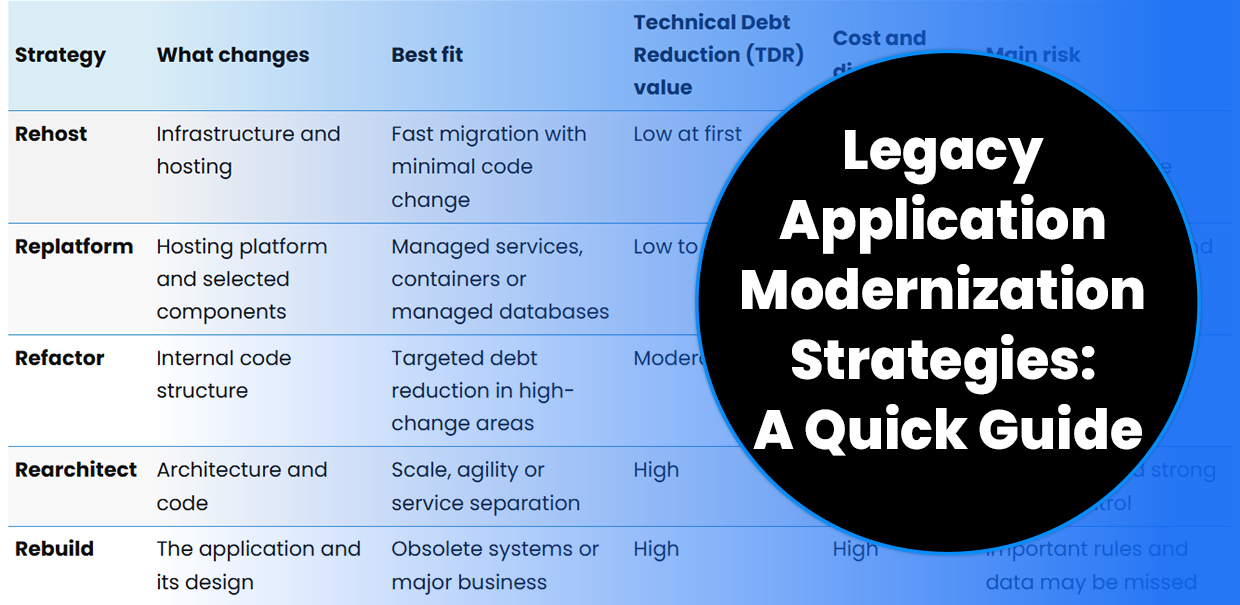
The Legacy Application Modernization Strategies: Quick Reference
Technical debt reduction (TDR) is the work of removing outdated code, weak integrations, missing documentation and other issues that make software harder to change. AI can address TDR faster and more cost effectively by analyzing code, mapping dependencies, documenting business rules, identifying security issues, drafting upgrade plans and generating tests.
| Strategy | What changes | Best fit | Technical Debt Reduction (TDR) value | Cost and disruption | Main risk |
|---|---|---|---|---|---|
| Rehost | Infrastructure and hosting | Fast migration with minimal code change | Low at first | Lower and faster | Old limits and integrations move with the app |
| Replatform | Hosting platform and selected components | Managed services, containers or managed databases | Low to moderate | Moderate | Platform changes and integrations need robust testing |
| Refactor | Internal code structure | Targeted debt reduction in high-change areas | Moderate | Moderate | Scope can expand without tests |
| Rearchitect | Architecture and code | Scale, agility or service separation | High | Moderate to high | Interfaces need strong design control |
| Rebuild | The application and its design | Obsolete systems or major business change | High | High | Important rules and data may be missed |
| Replace | The application with another product | A suitable SaaS or packaged option exists | Variable | Variable | Vendor, data and fit limits |
Now, let’s break down exactly how you can maximize TDR with your legacy app modernization strategy.
Start With the Business Outcome
Before choosing a technical path, define the result. Finance may need less support work. Operations may need faster case handling. Product may need a mobile channel or new workflow.
Use this short test:
| Question | Ask This Instead | Why It Matters | What to Gather |
|---|---|---|---|
| What problem are we fixing? | Where are we losing time, money or customers? | Keeps the project focused on a real business problem | Examples of delays, errors, complaints or extra work |
| What needs to improve? | Which task, customer experience or report should work better? | Defines the result the project must deliver | A short list of must-have changes |
| What cannot break? | Which rules, records or outside connections must keep working? | Protects daily operations during the change | Process notes, data owners and key dependencies |
| How much growth is expected? | How many users, orders or locations may we support? | Helps prevent the solution from falling behind growth | A simple forecast and workload estimate |
| What can we invest? | What budget, timeline and disruption can we accept? | Helps select a realistic modernization path | Approved budget, deadline and executive sponsor |
Technical debt is the extra effort created when poor software quality makes change harder, according to Fowler’s definition. Technical debt reduction (TDR) is not the goal by itself. Reduce debt that blocks a business need, then measure release effort, defects or support work. Include integration debt, data quality and missing tests in the review, not only old code.
Match the Strategy to the Application
Rehosting moves an application to new infrastructure with little or no code change. This approach takes very little time, but old software limits remain.
Replatforming moves an application to a managed environment with targeted changes. Examples include containers and managed databases. This can be a good choice when hosting or scaling creates avoidable work.
Refactoring improves code structure without adding a feature. This is best for applications that take too long to change or create defects, but provides a function that is still valuable in and of itself. Tie the scope to a business need to avoid spending on optimization that won’t meaningfully improve workflows.
Rearchitecting redesigns an application for scale, agility or service separation. This is a good fit for systems where monolithic architecture blocks scale or the ability to add independent features. It requires careful domain and interface design to ensure that the new architecture retains (or improves) the performance of the old one while adding the desired modularity.
Rebuilding develops the application again with a new design and technology base. This is a great choice for obsolete systems or unmet business needs. Start with an ideal user journey, not a preferred framework. Allow the tech base to be decided by the need, thus avoiding said need going unmet because of a snap decision regarding the platform.
Replacing moves from the legacy application to a packaged or software-as-a-service (SaaS) product. This can be a good route when there is an out-of-the-box platform that fits your needs, and deployment speed is a high priority. Review data, integrations, licensing and vendor limits before pulling the trigger here.
One portfolio may need several approaches. You might rehost a stable system, refactor a high-change module and replace a commodity function. Map all planned integrations before choosing a path, because a small application can still carry major business risk through shared data or critical interfaces.
Use AI to Accelerate TDR
AI can reduce manual work when engineers carefully set limits and verify each result. A quality AI software developer can provide tools that assess code, draft plans, automate steps and support code changes.
| TDR activity | AI can help with | Human control |
|---|---|---|
| Discovery | Summarizing modules and dependencies | Confirming findings with owners |
| Code analysis | Finding patterns and risky paths | Ranking issues by business priority |
| Documentation | Drafting technical documentation | Testing it against live workflows |
| Planning | Suggesting upgrade sequences | Approving scope and rollback plans |
| Testing | Generating test cases | Requiring domain and security review |
| Transformation | Drafting code changes | Reviewing, testing and deploying |
| Governance | Flagging access, security or compliance gaps | Approving controls before release |
The value comes from focusing people on decisions, exceptions and checks. AI cannot know which workflow matters most or which rule supports compliance, so business leaders must provide that context. Keep source code, customer data and prompts inside approved environments, and record who approved each generated change throughout the entire process.
Build a Phased Modernization Roadmap
Start with an application inventory, dependency map, business case and target outcomes. This is best accomplished through an iterative path, beginning with a pilot that tests a hard assumption without risking the most critical workflow.
| Phase | Ask This Instead | What You Produce | Ready to Move On When |
|---|---|---|---|
| Discover | What does the system do, and what does it connect to? | A simple map of the system, data and risks | The people who own the work confirm the findings |
| Prioritize | Which problem should we fix first? | A short list ranked by business value | The project sponsor agrees on the order |
| Design | What should we change, and what should stay? | A practical change and migration plan | Key data, connections and responsibilities are clear |
| Prove | Can we test the plan on a small part of the system? | A working pilot | Users confirm that the pilot solves the right problem |
| Deliver | How can we launch without disrupting daily work? | A step-by-step launch plan with a backup option | Rollback steps are ready and tested |
| Learn | Did the change deliver the expected result? | A results review and next-step plan | Findings guide the next release or phase |
Laying out this roadmap from the outset assists in assigning staff to each step, setting measurable benchmarks for success, and creating a ballpark deployment timeline.
Choose a Business-First Partner
Modernization works best when architecture connects to a business result. 7T’s team applies a “Business First, Technology Follows” approach to custom software, process automation, cloud solutions and AI-enabled Digital Transformation.
Its team brings in business analysis, program management, design and engineering early. 7T’s leadership also uses client-approved user-interface/user experience (UI/UX) designs before development and offers a fixed-cost model for many projects.
The best legacy application modernization strategies remove the constraint blocking the next business outcome. Rehost for speed, replatform for managed services, refactor for code debt, rearchitect for scale, rebuild when the foundation no longer fits and replace when a product meets the need. Use AI for discovery, planning, testing and code work, with human review at the center. Explore 7T’s custom software services, AI/ML services and cloud and DevOps services when TDR must support a measurable business case.
7T has offices in Dallas and Houston, with clients across the globe. For a legacy application modernization project, contact 7T.