Between May 2025 and April 2026, our research team evaluated more than 20 agentic AI platforms across the enterprise and mid-market landscape. We selected the top five based on a weighted scoring algorithm using these factors:
- Orchestration Capability (25%): multi-step, goal-directed execution across tools and systems
- Integration Flexibility (20%): native connector breadth, API coverage, and cross-system reach
- Enterprise Scalability (20%): production readiness, compliance support, and volume capacity
- Ease of Deployment (15%): time-to-value for non-specialist teams
- Governance Maturity (10%): audit trails, human-in-the-loop controls, and role-based access management
- Pricing Transparency (10%): clarity of total cost of ownership, including licensing, usage fees, and hidden costs
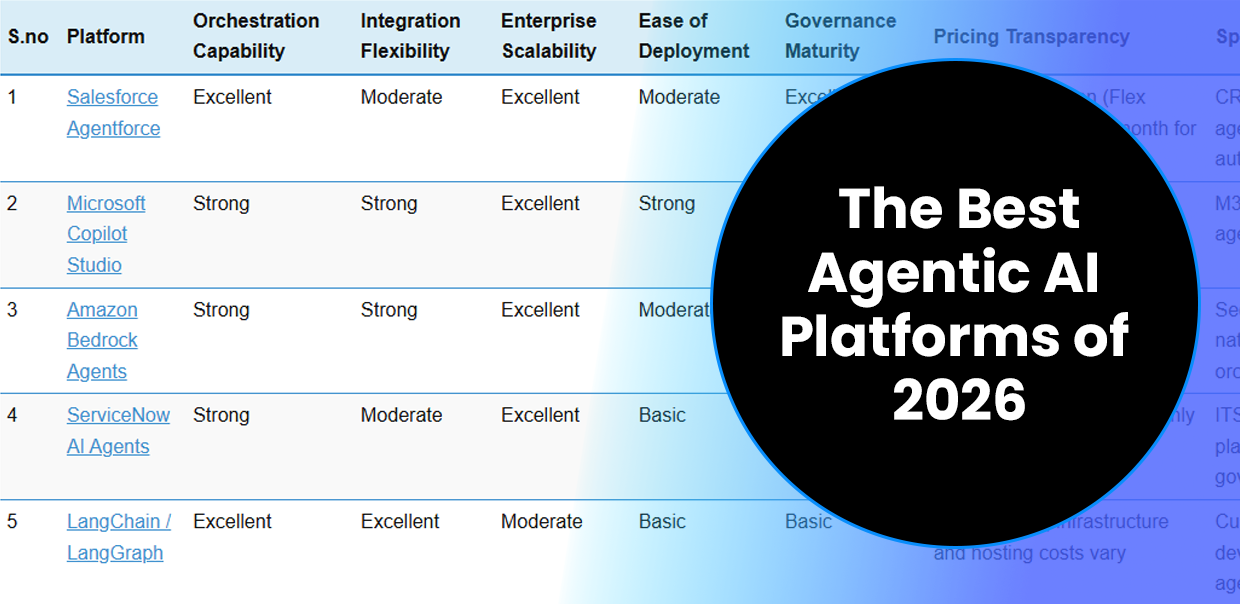
The Best Agentic AI Platforms in 2026
| # | Platform | Orchestration Capability | Integration Flexibility | Enterprise Scalability | Ease of Deployment | Governance Maturity | Pricing Transparency | Specialty |
|---|---|---|---|---|---|---|---|---|
| 1 | Salesforce Agentforce | Excellent | Moderate | Excellent | Moderate | Excellent | $0.10/conversation (Flex Credits); $165+/user/month for Sales Cloud | CRM-native agentic automation |
| 2 | Microsoft Copilot Studio | Strong | Strong | Excellent | Strong | Strong | $200/month per 25,000 messages + M365 base license | M365-embedded agent building |
| 3 | Amazon Bedrock Agents | Strong | Strong | Excellent | Moderate | Excellent | Consumption-based; no public rate card | Secure AWS-native orchestration |
| 4 | ServiceNow AI Agents | Strong | Moderate | Excellent | Basic | Excellent | Custom enterprise pricing only | ITSM-led cross-platform governance |
| 5 | LangChain / LangGraph | Excellent | Excellent | Moderate | Basic | Basic | Open-source; infrastructure and hosting costs vary | Custom developer-built agent logic |
Salesforce Agentforce, for CRM-Native Agentic Automation
Powered by the Atlas Reasoning Engine and grounded in Data Cloud, Agentforce is the market leader for CRM-native agentic workflows, with more than 8,000 customers and $900 million in AI and Data Cloud revenue within six months of launch. It delivers autonomous sales, service, and marketing orchestration directly inside the Salesforce data model, reducing hallucination risk by grounding agent decisions in structured CRM data rather than open-ended generation. Organizations already invested in Salesforce who want to extend its capabilities into enterprise integration workflows will find Agentforce the most native path forward.
Third-party reviewers consistently note that Agentforce’s value is proportional to an organization’s Salesforce investment. Workflows that span non-Salesforce systems, such as SAP ERP or Workday, require MuleSoft or custom connector development, which adds licensing costs and implementation time
- Orchestration Capability: Excellent
- Integration Flexibility: Moderate
- Enterprise Scalability: Excellent
- Ease of Deployment: Moderate
- Governance Maturity: Excellent
- Pricing Transparency: $0.10/conversation (Flex Credits); $165+/user/month for Sales Cloud
Summary of Online Reviews
Customers highlight “unmatched depth of integration,” “powerful multi-agent orchestration for complex workflows,” and “mature ecosystem of apps and integrations.” Common concerns include “steep learning curve,” “complex pricing structure with hidden costs,” and “requirement for certified administrators to manage advanced configurations.”
Microsoft Copilot Studio, for M365-Embedded Agent Building
Microsoft Copilot Studio gives enterprise teams a low-code path to building AI agents that operate natively inside Teams, SharePoint, Outlook, and Word, backed by more than 1,400 Power Platform connectors and the March 2026 GPT-5 integration via Azure OpenAI. The Entra Agent ID governance layer provides centralized identity and access management across all deployed agents, making it a strong fit for Microsoft-standardized organizations.
Third-party analysis indicates that Copilot Studio’s performance degrades when the underlying M365 data is disorganized or when workflows touch systems outside the Power Platform’s catalog. CIOs managing mixed or SAP-heavy stacks report higher integration overhead than the platform’s marketing implies.
- Orchestration Capability: Strong
- Integration Flexibility: Strong
- Enterprise Scalability: Excellent
- Ease of Deployment: Strong
- Governance Maturity: Strong
- Pricing Transparency: $200/month per 25,000 messages + M365 base license
Summary of Online Reviews
Customers value “deep Microsoft ecosystem integration eliminating data silos,” “unified platform connecting departments and processes,” and “enterprise-grade security and compliance tools.” Common concerns include “complex pricing structure making total cost difficult to predict,” and “steep learning curve due to unintuitive interface.”
Amazon Bedrock Agents, for Secure AWS-Native Orchestration
Amazon Bedrock Agents is a managed service combining IAM-based access control with a multi-model architecture that supports foundation models from Anthropic, Meta, Mistral, and others without forcing a single-model commitment. The AgentCore runtime handles memory, session management, tool access, and observability for agentic workloads at scale, making it one of the most production-ready options for enterprises already operating on AWS. For organizations building out broader cloud and AI infrastructure, Bedrock integrates naturally into an AWS-native architecture.
Independent practitioners note that building agentic workflows on AgentCore creates compounding dependencies across runtime, governance, and observability layers, and these dependencies grow harder to unwind over time. Enterprises should model their exit architecture alongside their build plan.
- Orchestration Capability: Strong
- Integration Flexibility: Strong
- Enterprise Scalability: Excellent
- Ease of Deployment: Moderate
- Governance Maturity: Excellent
- Pricing Transparency: Consumption-based; no public rate card
Summary of Online Reviews
Reviewers frequently point to Bedrock’s “unified API” and serverless architecture as standout advantages, with enterprise engineers noting that teams were “able to show working GenAI features to stakeholders by the end of the first sprint.” The most common critique is cost opacity: reviewers note that “trying to predict and track costs early on was a nightmare,” particularly during high-volume experimentation sprints.
ServiceNow AI Agents, for ITSM-Led Cross-Platform Governance
ServiceNow ranked No. 1 for Building and Managing AI Agents in the 2025 Gartner Critical Capabilities report for RPA. Its AI Control Tower, a centralized command center managing agents across ServiceNow and third-party platforms (including Microsoft and Salesforce) represents the strongest cross-platform governance capability in this comparison. For enterprises running significant ITSM deployments, the platform delivers autonomous L1 ticket triage, cross-functional approvals, and known-incident resolution at scale.
ServiceNow’s own materials describe agentic AI adoption as “a massive operating model change, not a mere software installation.” The platform requires specialized administrator certifications, dedicated IT resources, and phased implementation planning, which makes early-stage budget modeling difficult for teams evaluating from a fresh start.
- Orchestration Capability: Strong
- Integration Flexibility: Moderate
- Enterprise Scalability: Excellent
- Ease of Deployment: Basic
- Governance Maturity: Excellent
- Pricing Transparency: Custom enterprise pricing only
Summary of Online Reviews
Enterprise reviewers praise ServiceNow’s ability to “cut down on manual effort by automatically taking care of tasks such as ticket assignment and resolution suggestions,” with executive sponsors describing agents as “a strategic enabler that helps us operate smarter and move faster.” The AI Control Tower receives specific recognition for providing “visibility and control without the overhead.” The primary critique is implementation complexity, with reviewers noting that “setup and configuration is not trivial” and that AI capabilities layered on top of existing licensing can add up faster than expected.
LangChain / LangGraph, for Custom Developer-Built Agent Logic
LangChain and its companion framework LangGraph are the dominant open-source options for engineering teams that want full control over agent reasoning loops, tool orchestration, and memory management. LangGraph’s stateful, graph-based orchestration enables complex multi-step workflows that can loop, branch, and adapt based on intermediate results, a level of customization that closed enterprise platforms cannot match. For organizations pursuing a fully bespoke solution, LangChain pairs naturally with custom software development to build proprietary agentic systems on their own terms.
The trade-off is operational overhead. LangChain and LangGraph provide the framework, not the enterprise infrastructure. Teams building for production must layer in monitoring, compliance tooling, access controls, and deployment architecture that enterprise platforms bundle natively.
- Orchestration Capability: Excellent
- Integration Flexibility: Excellent
- Enterprise Scalability: Moderate
- Ease of Deployment: Basic
- Governance Maturity: Basic
- Pricing Transparency: Open-source; infrastructure and hosting costs vary
Summary of Online Reviews
Developer reviewers consistently praise LangChain’s “modular design and ease of integration” with vector databases, APIs, and LLM providers, noting it “transforms how quickly teams can prototype and deploy AI solutions.” Users highlight that its flexibility allows organizations to “switch between different LLM providers without rewriting code.” The near-universal critique is a steep learning curve, with reviewers noting that “frequent breaking changes between versions can make it tough to maintain a production-grade project” without dedicated engineering resources.
Find the Right Agentic AI Implementation Partner
Selecting the right best agentic AI platform is only the first step. Gartner projects that 40% of enterprise applications will include task-specific AI agents by the end of 2026, up from less than 5% in 2025. The implementation gap, not model capability, is the primary challenge: integrating agents into fragmented workflows shaped by legacy systems, siloed data, and complex approval layers requires deep technical expertise and a clear business strategy before a single line of code is deployed.
At 7T, we’re guided by a “Business First, Technology Follows” philosophy. As such, the 7T development team works with company leaders who are seeking to solve real operational problems and drive ROI through AI-driven Digital Transformation and AI development and implementation. Rather than defaulting to whichever platform has the largest marketing budget, 7T helps organizations evaluate, deploy, and integrate the right agentic AI platform based on their systems, goals, and operational needs.
7T has offices in Dallas and Houston, but our clientele spans the globe. If you’re ready to discuss your Digital Transformation project, contact 7T today.