If your company loses time to manual work, disconnected systems or slow decisions, the choice between AI Transformation vs. Digital Transformation can seem complex. Fortunately, all you really need to make a decision is a business problem that needs solving, and your planned measurement for success.
IBM defines Digital Transformation as a business strategy that applies digital technology across an organization. AI transformation is a subset of Digital Transformation this strategy that specifically looks to modern AI and machine learning (ML)
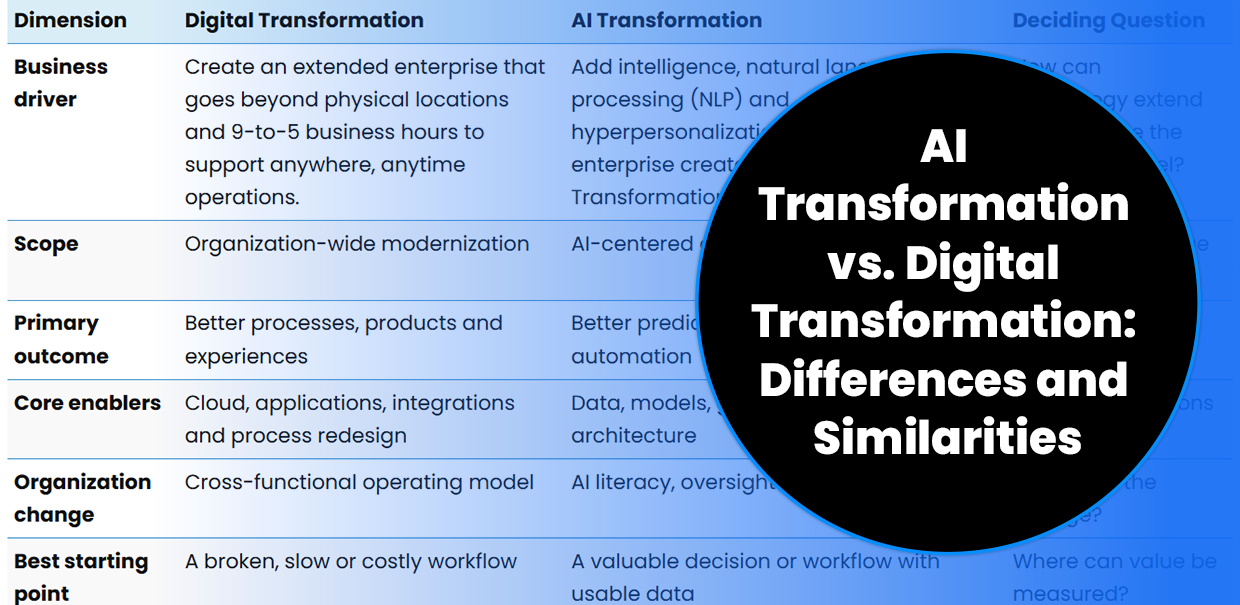
| Dimension | Digital Transformation | AI Transformation | Deciding Question |
|---|---|---|---|
| Business driver | Create an extended enterprise that goes beyond physical locations and 9-to-5 business hours to support anywhere, anytime operations. | Add intelligence, natural language processing (NLP) and hyperpersonalization to the extended enterprise created through Digital Transformation. | How can technology extend and improve the business model? |
| Scope | Organization-wide modernization | AI-centered evolution | What must change first? |
| Primary outcome | Better processes, products and experiences | Better prediction, generation and automation | Which result matters most? |
| Core enablers | Cloud, applications, integrations and process redesign | Data, models, governance and AI-ready architecture | Are the foundations ready? |
| Organization change | Cross-functional operating model | AI literacy, oversight and adoption | Who owns the change? |
| Best starting point | A broken, slow or costly workflow | A valuable decision or workflow with usable data | Where can value be measured? |
What Each Transformation Is Designed to Change
Digital Transformation can replace legacy apps, connect data, redesign workflows, move workloads to the cloud and improve customer or employee experiences. AI can support these efforts, and is sometimes even the most efficient way to do so, but it is not required for every project.
A helpful way to view AI Transformation is as a focused step within a Digital Transformation program. It adds machine learning, natural language processing, computer vision, genAI or similar tools where they can improve a measurable process. It also needs robust and clean data, model checks, security and human review.
| Transformation | Typical Change | Business Test |
|---|---|---|
| Digital | Replace disconnected tools with integrated workflows | Can teams complete work faster and with less re-entry? |
| AI | Add prediction, generation or intelligent recommendations | Is AI an efficient way to improve or automate hard work? |
| Combined | Modernize the workflow, then add intelligence | Can the company scale the result safely and cost-effectively? |
Where AI Transformation vs. Digital Transformation Overlap
Both approaches seek better business results, and both can require process redesign, data integration, technology spending and changes to team roles. Neither works, however, when a company treats software as a stand-alone purchase. Robust integration is key to truly adding value with any modern tech.
The difference between AI Transformation vs. Digital Transformation is the center of the work. Digital Transformation asks how the business should run through digital systems, whereas AI Transformation asks where enhanced intelligence can improve those systems.
| Shared Foundation | Digital Transformation Emphasis | AI Transformation Emphasis |
|---|---|---|
| Business strategy | Leverage software to digitize business processes | Leverage AI/ML to reduce workloads throughout these processes |
| Data | Connect and govern information through digital databases | Prepare data for model training and retrieval/evaluation for AI tools |
| Technology | Integrate existing apps and infrastructure, filling gaps with new software where necessary | Add models, orchestration and automated monitoring to keep everything running more efficiently |
| People | Change roles and workflows | Build AI literacy, trust and human review |
When AI Should Become Part of a Broader Transformation Strategy
Use AI when it solves a clear business problem better than standard software or process redesign alone. Strong candidates have a repeatable workflow, usable data and a clear success measure. This evaluation is one that can be made a bit easier with a quality consultant, but business leaders can also use our AI Genie to identify opportunities.
Choose Digital Transformation first when your existing systems cannot share data, the process is non-linear or teams lack the necessary information to do their work in a timely manner. A model cannot fix a broken workflow, and often needs many of the same resources that your staff needs to automate a process. As a result, adding a model may only make the problem move faster if the proper infrastructure is not in place.
Choose AI first when the process is already established and stable, the data is governed and better prediction or automation can change the economics. Use both when a modern platform is needed before AI can work at scale, but there is a clear avenue for it to add value.
| Business Signal | Likely Starting Path | First Step |
|---|---|---|
| Disconnected systems | Digital Transformation | Map the workflow and integration gaps |
| Repetitive work with clear rules | Digital plus automation | Automate the highest-volume handoffs |
| Data-rich decisions | AI Transformation | Define the decision, data and success metric |
| New customer-facing product | Combined strategy | Validate the use case before scaling the platform |
How 7T Connects Both Approaches to Business Results
7T’s team takes a simple position: “Business First, Technology Follows.” Its Digital Transformation services connect process redesign, custom software, automation and cloud solutions to a business goal. Its custom AI development services add predictive analytics, intelligent workflow automation and machine learning when those tools fit the problem.
This approach helps leaders avoid two errors. The first is buying AI before defining the use case. The second is modernizing systems without a way to measure success. 7T’s leadership also describes a fixed-cost model for 90% of its projects and open project tracking through JIRA. These are 7T service practices, not industry benchmarks. 7T case studies cite a 5X ROI for Simplex Group and 10X revenue scaling for PHP Agency.
The practical conclusion about AI Transformation vs. Digital Transformation is simple. They are not competing labels. Digital Transformation establishes the operating foundation. AI Transformation extends it when intelligence can improve a decision, workflow, product or customer experience. Begin with the result you need, the process that blocks it and the evidence you can measure. Then choose modernization, AI or both.
More questions about AI transformation vs. Digital Transformation? Discuss With 7T

Related Posts