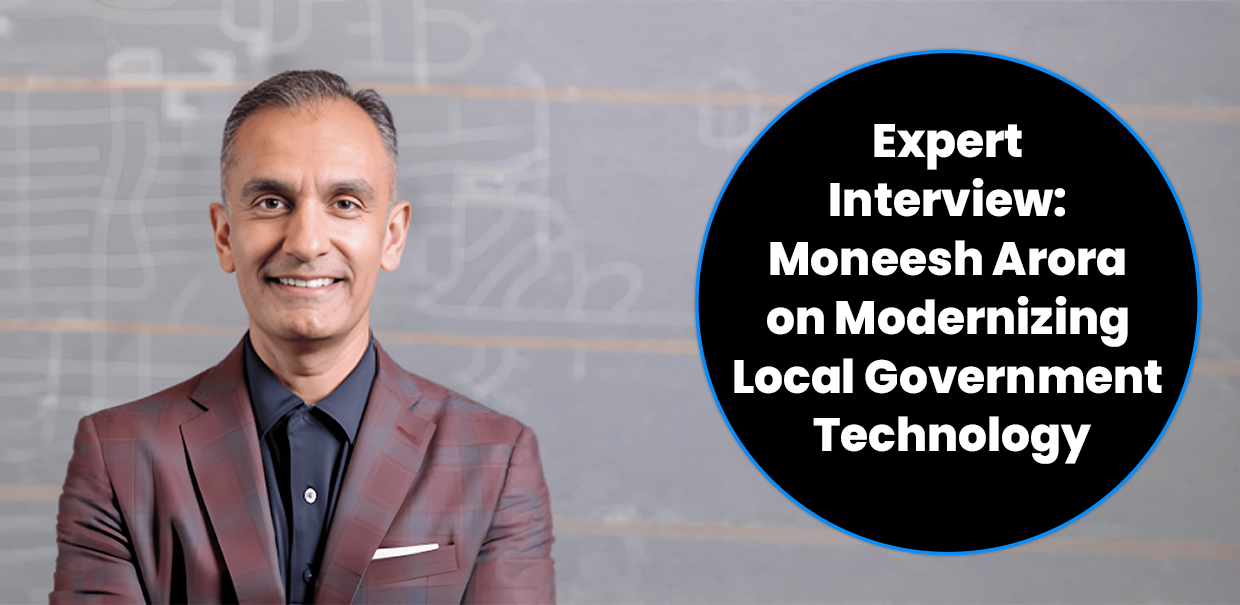
At 7T, our business-first philosophy means we believe technology should simplify complex workflows and drive real change. That sentiment is shared by Moneesh Arora, CEO of gWorks, the top-ranked cloud software platform for municipalities, counties, and utility districts under 50,000 population.
gWorks has built its reputation on replacing the disconnected legacy systems that hinder local governments with a unified platform connecting financial management, utility billing, permitting, GIS, and work order management. We talked with Moneesh about what it takes to modernize thoughtfully, connect data meaningfully, and build technology that people actually use.
7T: Technology modernization is often pitched as a software problem. From what you’ve seen with gWorks customers, where does the real friction usually come from?
Moneesh Arora: More often than not the friction is process, not software. When a city has run on spreadsheets and paper for fifteen years, every workflow, every approval chain, every habit has been built around those tools. Swap in new software without touching the process and people just route around it: now you own expensive software nobody uses. The vendor usually takes the blame, and sometimes deserves it, but modernization projects are almost always stalled in the process work. What makes these efforts succeed is mapping how work actually flows through the organization before you configure anything. The technology has to fit that reality or adoption dies.
7T: The government software market has large, established players. Where does gWorks fit?
Moneesh Arora: In the part of the market the big players were not designed for. Tyler Technologies is the largest company in our industry and does strong work with counties and mid-size cities, and regional providers like BS&A have deep roots in their home states. But there are more than 19,000 municipalities in America, and the vast majority have fewer than 50,000 residents, small cities and utility districts that cannot absorb enterprise pricing or an eighteen-month implementation. That’s who gWorks serves: 2,000+ local governments across 48 states, on one cloud platform covering fund accounting, utility billing, permitting, GIS, and work order management, implemented for a staff of five, not five hundred. We aren’t competing with Tyler for a county of 300,000. We want to be the obvious choice for the town of 3,000.
7T: Where do municipalities most often lose value between collecting data and acting on it?
Moneesh Arora: At the manual step. Someone compiles information by hand, or reconciles multiple sources, and that’s where hours go, errors creep in, and decisions are delayed. Utility billing and month-end financial reporting are the classic cases. The data exists, but it is scattered across systems that don’t talk to each other, so a staff member rebuilds the picture every month. Eliminate that step and two things happen: you get the time back, and you make decisions on fresher information. That’s the ROI that’s hardest to quantify in a proposal, and most obvious to the people living it after go-live.
7T: Cybersecurity keeps coming up in conversations with local governments. How do you usually recommend a small city with limited IT staff approach it?
Moneesh Arora: Start by dropping the assumption that you are too small to be a target. Ransomware groups do not skip a town of 2,000 people, they go after it because the utility billing system runs on a machine under a desk and the backups sit on the same network. Most small cities cannot staff their way out of this. There is no security hire coming. So the infrastructure has to do the work. A modern cloud platform gives a small city the patching, encryption, monitoring, and backup discipline a large enterprise gets, without hiring for it. People debate features and price, but for a small government, security is the strongest argument for getting off legacy systems.
7T: What’s your advice for a local government leader who knows they need to modernize but isn’t sure where to start?
Moneesh Arora: Start with the pain point that costs the most: for most of our clients, that’s utility billing or financial reporting. Getting those right has an immediate, visible payoff, and that visibility buys the internal credibility to tackle the next system. Trying to modernize everything at once is how projects stall. Pick the highest-pain problem, solve it completely, build from there. One thing about timing: waiting carries a cost now in a way it did not ten years ago; support windows close and vendors retire products on their schedule, not yours. The governments that start early choose their pace. The ones that wait have it chosen for them.
To learn more about gWorks, visit gworks.com.