Agentic AI is the future of AI implementation for businesses of most sizes, expanding AI’s capabilities from ask/answer and data entry workloads to truly assistive functionality. The cost of any AI implementation typically scales with capability and model size, and most businesses would rather not go in blind to an investment as significant as this.
This report analyzes agentic AI implementation costs, vendor quotes, and post-deployment cost data from more than 90 enterprise and mid-market organizations that had completed or were actively scoping agentic AI projects. Costs were organized by agent type, project complexity, and industry vertical to produce benchmarks. The figures broken down in this piece have been cross-referenced with primary research from McKinsey, Deloitte, and Intellectyx to give business decision-makers a grounded picture of what agentic AI implementation actually costs and returns in 2026.
Agentic AI Implementation Costs by Agent Type
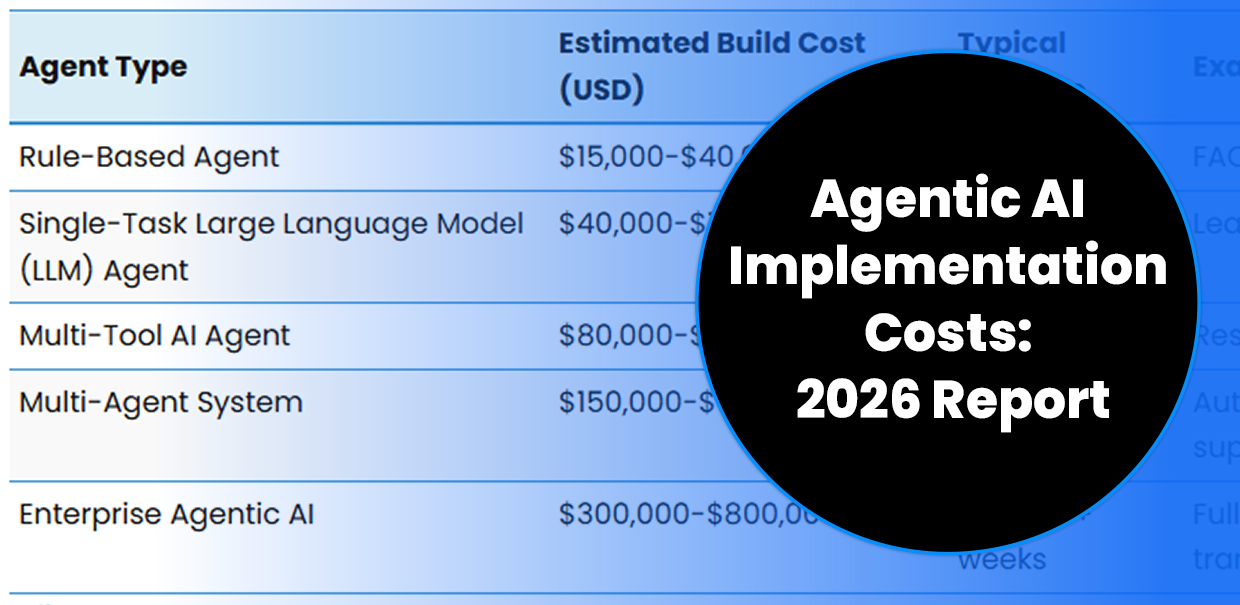
The single most consequential variable in any agentic AI implementation budget is the deployed agent’s type and complexity. Build costs range from $15,000 for a focused, single-task agent to more than $800,000 for a full enterprise multi-agent system; most mid-market deployments fall from $60,000 to $180,000.
The Agentic AI Implementation Cost by Agent Type: 2026
| Agent Type | Estimated Build Cost (USD) | Typical Timeline | Example Use and Scope |
|---|---|---|---|
| Rule-Based Agent | $15,000-$40,000 | 4 to 8 weeks | FAQ chatbot, ticket router, basic process automation |
| Single-Task Large Language Model (LLM) Agent | $40,000-$100,000 | 8 to 14 weeks | Lead qualifier, document summarizer, scheduling agent |
| Multi-Tool AI Agent | $80,000-$180,000 | 12 to 20 weeks | Research agent, CRM automation, proposal generator |
| Multi-Agent System | $150,000-$ 350,000 | 16 to 28 weeks | Autonomous sales pipeline, HR onboarding, customer support orchestration |
| Enterprise Agentic AI | $300,000-$800,000+ | 24 to 40+ weeks | Full workflow automation, agentic ERP layer, enterprise transformation programs |
All build cost ranges and timelines sourced from Intellectyx, 2026, cross-referenced with Uvik, 2026.
Key Findings:
- The jump from a multi-tool agent ($80,000-$180,000) to a multi-agent system ($150,000-$350,000) reflects more than added components. Multi-agent systems require orchestration layers, inter-agent communication protocols, and coordination logic that each carry their own development and testing costs, independent of the underlying model.
- Enterprise agentic AI implementations frequently exceed $800,000 when compliance requirements, legacy system integration, or custom model fine-tuning are in scope. For heavily regulated industries, such as healthcare and financial services, compliance infrastructure alone can account for $50,000-$100,000 of the total build budget, per Intellectyx.
- A rule-based agent is the lowest-cost entry point, but it also carries the lowest autonomy ceiling. Brands that start here and later require more sophisticated reasoning often must rebuild rather than extend, making the full lifecycle cost of a rule-based agent higher than that of a more capable agent scoped correctly from the start.
Total Cost of Ownership: What Agentic AI Actually Costs in Year One
Build cost is the number you’ll see in custom agentic AI dev vendor proposals. Total cost of ownership is the number in your year-end budget reviews. For most organizations, the two are not close: enterprise budgets underestimate the true year-one total cost of ownership (TCO) of agentic AI by 40-60%, according to Hypersense, primarily because infrastructure, integration, governance, and failure recovery are priced separately or not at all.
The Agentic AI Year-One TCO: Example Breakdown for a Mid-Range Agent, 2026
| Cost Category | Amount (USD) | What It Covers |
|---|---|---|
| Development (vendor quote) | $80,000 | Architecture, development, testing, initial deployment |
| Infrastructure (Year 1) | $12,000 | Cloud compute, API hosting, monitoring tools |
| Integration | $15,000 | CRM, ERP, or legacy system connections |
| Visible Total | $107,000 | Sum of development, infrastructure, and integration |
| Hidden Costs Buffer (30%) | $32,100 | Delays, scope changes, governance setup, rework |
| True Year-1 TCO | $139,100 | Full first-year cost including visible and hidden spend |
All figures sourced directly from Hypersense’s TCO guide, not meant to be a cost estimate for 7T services.
Key Findings:
- The 40-60% underestimation gap is consistent across industries and project types, per Hypersense. The primary cause is that infrastructure, integration, and governance are treated as items to be added later rather than as architectural requirements priced from the start.
- Annual ongoing costs after year one typically run 15-25% of the original build cost, per Hypersense. For a $150,000 agent, that translates to $22,500-$37,500 per year in maintenance, model updates, and operational support, sustained as long as the agent remains in production.
- Token-level operating costs introduce a compounding variable most initial budgets ignore entirely. A single agentic workflow can consume 10,000-50,000 tokens per completed task, compared to 500-1,000 tokens for a standard chatbot exchange, per the SaaS Library. At production scale, token spend grows in proportion to adoption and must be modeled as a recurring line item before deployment.
Agentic AI ROI Benchmarks
Implementation cost is only half of the business case. Published ROI benchmarks from 2025-2026 show that well-scoped agentic AI deployments recover their initial investment within the first year and compound returns significantly in years two and three, particularly for firms running continuous improvement programs.
The Agentic AI ROI Benchmarks: 2026
| Return Metric | Benchmark | Source |
|---|---|---|
| Average Year-1 ROI, enterprise deployments | 41% | SaaS Library, 2026 |
| Average Year-2 ROI, enterprise deployments | 87% | |
| Average Year-3 ROI, enterprise deployments | 124%+ | |
| Return per dollar invested (customer service agents) | $3.50 per dollar | Fin.ai, 2026 |
| High-performer ROI (customer service agents) | 3-6x | |
| Organizations reporting measurable productivity gains from AI | 66% | Deloitte, 2026 |
| Organizations reporting positive EBIT contribution from AI | 37% | McKinsey via Digital Applied |
Key Findings:
- The 41% average year-one ROI is a median figure, not a ceiling, per the SaaS Library. High-performing deployments in customer service and back-office automation routinely reach 3-6x returns within 12 months. The organizations at the lower end of the range are typically those that deployed agents without redesigning the underlying workflow, limiting what the agent can automate and compressing the savings it can generate.
- Year-three ROI exceeding 124% reflects the compounding effect of continuous agent improvement. Agents that are retrained, refined, and extended to adjacent workflows consistently outperform static deployments. Teams that treat agentic AI as a maintained, evolving product rather than a one-time implementation capture the majority of this long-term value.
- The gap between 66% of organizations reporting productivity gains, per Deloitte, and only 37% reporting positive EBIT contribution, per McKinsey, indicates that many companies are capturing task-level time savings without yet restructuring process costs to realize bottom-line impact. Closing that gap typically requires a second-stage workflow redesign effort beyond the initial agent deployment.
Primary Cost Drivers for Agentic AI Implementation
No two agentic AI projects carry the same budget because the primary cost drivers interact in ways that are non-linear and project-specific. Understanding these variables allows organizations to scope more accurately and identify where additional investment will produce the greatest leverage.
The Primary Agentic AI Implementation Cost Drivers: 2026
| Cost Driver | Lower-Cost Scenario | Higher-Cost Scenario |
|---|---|---|
| Agent Complexity | Single-task, narrow scope | Multi-agent, autonomous multi-step reasoning |
| LLM Selection | Open-source model (Llama, Mistral) | Proprietary API (GPT-5.6 Sol, Claude) |
| Integration Depth | Standalone, no legacy connections | ERP, CRM, electronic health record (EHR), or mainframe integration |
| Data Readiness | Clean, structured, pipeline-ready | Raw data requiring cleanup and governance build-out |
| Compliance / Security | Standard web application security | HIPAA, SOC 2, FedRAMP, or GDPR requirements |
| Team Location | Offshore or nearshore delivery partner | US/UK senior AI engineering team |
| Testing Rigor | Basic QA | Adversarial red-teaming and evaluation suites |
| Ongoing Maintenance | Minimal post-launch support | 24/7 monitoring with quarterly model updates |
Cost driver framework sourced from Intellectyx, 2026.
Key Findings:
- Integration depth is consistently the most underestimated cost driver at the enterprise level. A standard REST API integration adds $5,000-$20,000 per connection; a complex legacy system integration adds $20,000-$80,000 or more, per DigiSoft. Organizations operating fragmented or outdated system environments should treat integration as a standalone budget category, not a development sub-task.
- LLM selection carries more ongoing cost implication than most buyers anticipate at the time of scoping. Agentic AI costs $0.10-$1.00 per complex decision cycle, compared to roughly $0.001 per inference for traditional AI, a 100x to 1,000x difference in per-unit operating cost, per the SaaS Library. For agents processing high transaction volumes, that difference compounds into a significant recurring monthly line item.
- Data readiness is the single most common gating factor for agentic AI projects. Industry research estimates that data preparation and cleanup account for 60-80% of total AI project effort, per Keyhole Software. Organizations with clean, governed data assets launch faster, spend less on rework, and see stronger early ROI than those that attempt to build the agent and fix the data simultaneously.
Agentic AI Implementation Costs by Industry
An industry vertical shapes implementation cost through three primary mechanisms: compliance requirements, data complexity, and the density of existing system integrations an agent must connect to. The ranges below reflect production-grade, single-function agent deployments within each vertical.
The Agentic AI Implementation Cost by Industry: 2026
| Industry | Typical Use Case | Average Build Cost Range (USD) | Primary Cost Drivers |
|---|---|---|---|
| Financial Services | Fraud detection, compliance reporting, trading agents | $120,000-$500,000+ | Regulatory compliance, real-time data, audit trail requirements |
| Healthcare | Patient intake, clinical documentation, prior auth automation | $100,000-$400,000 | HIPAA compliance, EHR integration, clinical accuracy standards |
| Retail / E-Commerce | Customer service, inventory agents, personalization | $50,000-$200,000 | Catalog integration, scale, real-time personalization requirements |
| Professional Services | Research agents, document review, proposal automation | $60,000-$250,000 | Knowledge retrieval accuracy, multi-source integration |
| Manufacturing / Operations | Process automation, supply chain agents, quality control | $80,000-$300,000 | Equipment system integration, uptime requirements, process criticality |
All industry cost ranges sourced from Intellectyx, 2026.
Key Findings:
- Financial services and healthcare carry the highest implementation floors because compliance infrastructure is non-negotiable in production. Compliance infrastructure for a production-grade fintech AI agent runs $50,000-$100,000, per Intellectyx, and this is before any agent logic, integration, or operational overhead is added.
- Professional services firms face a cost profile driven by knowledge retrieval accuracy and multi-source integration requirements rather than compliance overhead. At $60,000-$250,000 for a production agent, this vertical also tends to see faster deployment timelines than financial services or healthcare, given lower regulatory build-out requirements and typically cleaner data structures.
- Manufacturing and operations organizations tend to see the fastest ROI on process automation agents despite mid-range agentic AI implementation costs. When an agent reduces manual review time or catches quality defects earlier in the production cycle, operational savings accrue on every run, making the business case faster to close than in knowledge-worker applications where productivity gains are harder to translate directly into cost reduction.
Scope Your Agentic AI Implementation Costs With 7T
The ranges in this report provide a starting benchmark, but your actual agentic AI implementation costs depend on the specific workflows, systems, and compliance requirements unique to your organization. 7T’s AI agent development services are built around a business-first approach, meaning we spend time understanding your needs before scoping a single line of development, so your investment is sized accurately from the start.
The 7T development team works with company leaders who are seeking to solve problems and drive ROI through Digital Transformation and innovative technologies like agentic AI. Before you commit to a budget, we help you define the expected value and the architecture your project requires, so your agentic AI implementation costs match the results you need.
7T has offices in Dallas and Houston, but our clientele spans the globe. To discuss your project and get a realistic agentic AI implementation cost estimate, contact 7T today.